Ellicott City Wood Flooring has spent more than 20 years on wood-flooring in Arbutus and the surrounding part of Baltimore County, and a good share of that work is repair rather than decoration. A soft spot by the back door, a run of boards lifted by a leak, a patch of floor that dips where a joist has given way: these are the jobs that bring owners to us, and they rarely stand alone.
When a floor fails, it usually fails because something else did first. Water came from a plumbing line, a window or a roof, or a structural member underneath stopped carrying its load. We treat the floor as one line in that larger repair, so the cause is fixed before new wood goes down and the finished floor is not undone a season later.
This page explains how we approach repair work in an owned Arbutus house, how a county home repair loan can sit behind a bigger project that includes the floor, and what paperwork we hand over so an owner, a lender or a loan officer can see exactly what was done.
Baltimore County’s Single Family Rehabilitation Loan Program
Baltimore County’s Department of Housing and Community Development runs a Single Family Rehabilitation Loan Program for owners of single-family, owner-occupied homes in the county. Our understanding of it comes from the county’s own published description as it appears in search results, so treat the details below as a starting point and confirm them with the department before planning around them.
What the program is designed to do
As the county describes it, the program offers income-eligible homeowners low-cost or no-cost loans to correct hazardous conditions, eliminate safety hazards, repair or replace major systems, and correct interior and exterior deficiencies. It also lists energy improvements, modifications for people with disabilities and the removal of lead-based paint hazards. Floors are not named anywhere in that list.
That matters, and we will not pretend otherwise. Whether a damaged floor qualifies is a decision for the county, made against its own definition of an interior deficiency. What we can do is describe the floor’s condition plainly and in writing, so the person reviewing the application has a clear picture of whether it is a hazard, a failed system or simply worn.
Who it is meant for
The description sets household income at or below 80 percent of the area median, and the property has to be a single-family house the owner lives in. The published maximum assistance is $35,000, which has to stretch across every repair in the project, not just one room.
In practice that cap tends to go first to roofs, heating, plumbing and anything that puts the household at risk. A floor repair that is tied to one of those, such as boards rotted by the same leak the roof contractor is fixing, is easier to describe as part of a single deficiency than a floor that is only dull or scratched.
The contractor requirement
The county’s description is direct on one point: repairs must be made by a licensed, insured contractor. Before any trade starts work under a county loan, ask to see a current Maryland Home Improvement Commission license and a certificate of insurance, and check both against the documents the program asks you to submit.
We would rather an owner verify every contractor on the job, including us, than find out at inspection that one piece of paperwork was missing. A loan that pays for several trades is only as clean as the weakest file in it.
Looking for wood-flooring closer to Savage? See Wood-Flooring in Savage.
When a Floor Is a Repair, Not a Cosmetic Job
Most wood floor calls are about appearance: traffic lanes, rug shadow, an orange oak finish an owner has grown tired of. Those are worth doing, but they are not deficiencies. A repair floor is one where the wood, the fasteners or the structure underneath has stopped doing its job.
Signs the problem is below the surface
Cupping, crowning and buckling are moisture problems before they are flooring problems. Cupped boards with raised edges usually mean water is reaching the underside, while buckling, where boards lift off the subfloor, often follows a sustained leak or a flood that saturated the room. Sanding a cupped floor flat before it dries out produces crowning once it does.
Soft or bouncing areas point toward the subfloor or a joist. Persistent nail pops and squeaky floorboards across a wide area can mean the subfloor has loosened from its framing. Small exit holes and fine, powdery frass along a board can indicate powderpost beetle, and hollow-sounding wood near a sill can signal termite damage, both of which need a pest professional before any carpentry.
How we read and document the damage
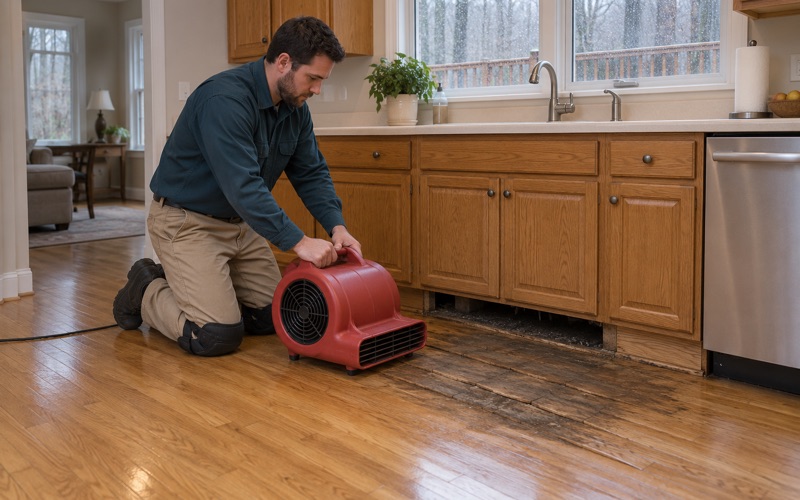
Water damage gets traced to its source, dried, and checked with a moisture meter before we commit to any replacement. We record readings room by room, along with photographs and the extent of the damaged area, so the record makes sense to an adjuster, a loan reviewer or a future buyer.
The written estimate that follows is itemized: board replacement by area, subfloor repair, sanding and finishing listed separately. If only part of a project is approved under a loan, an itemized estimate makes it easy to see which lines are in and which are not.
Repair methods that keep the floor whole
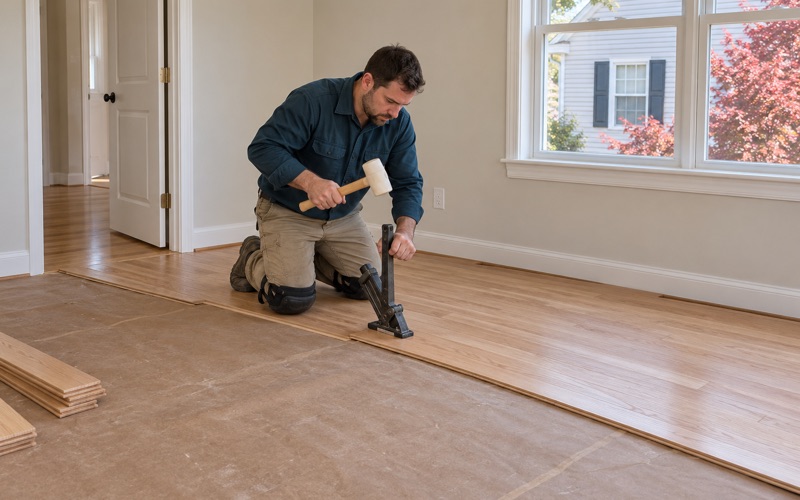
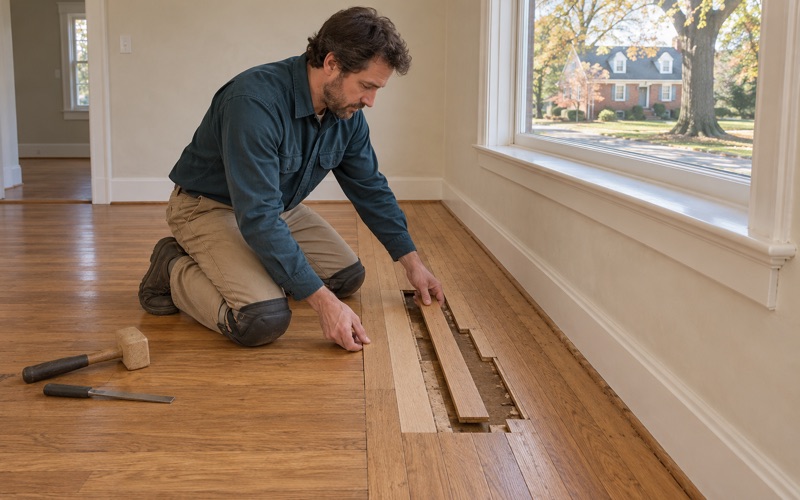
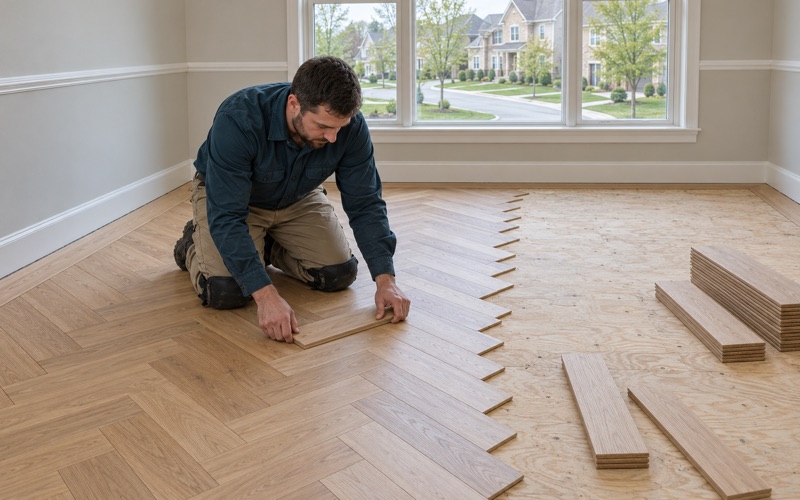
Damaged boards are cut out and replaced with matching tongue and groove stock, woven into the surrounding floor so there is no straight seam where the repair stops. The same weave-in repair closes the holes left where radiators, registers or an old wall once stood.
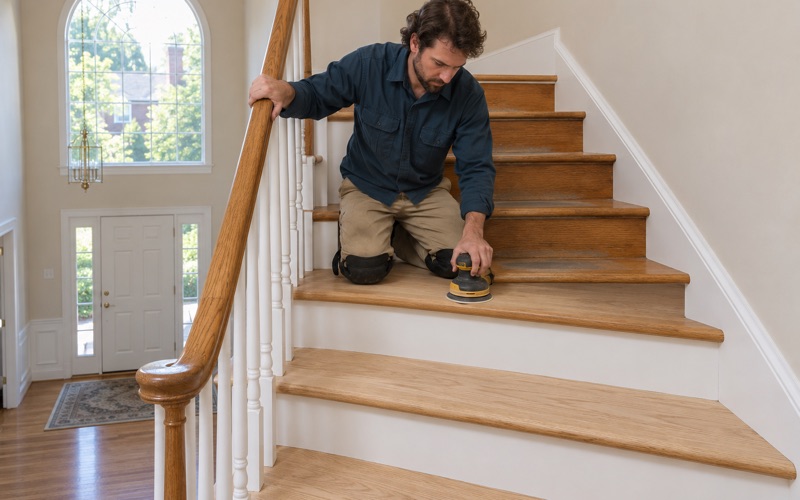
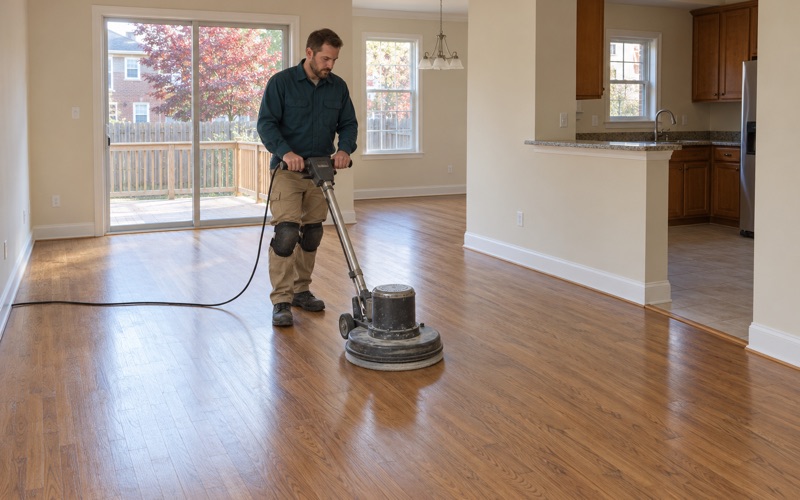
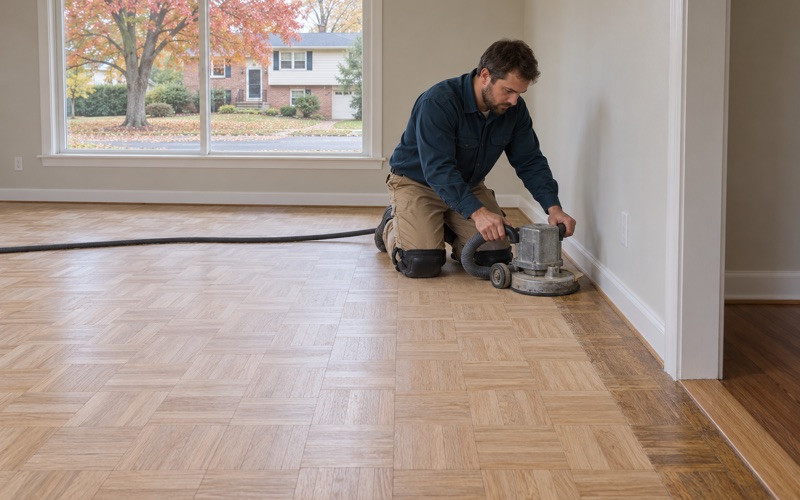
Where the subfloor itself has rotted, we cut back to sound material and replace it before any new wood goes on top. Only after the structure is firm and the moisture readings are steady do we sand and refinish, so the whole floor reads as one surface again.
Floors in Arbutus’s Owned Attached and Detached Houses
Arbutus is an unincorporated community and census-designated place in Baltimore County, so there is no town government between an owner and the county. The census area also takes in Halethorpe and Relay, and the University of Maryland, Baltimore County sits next door. For floor work, the county is the authority an owner deals with.
An owner-occupied community
According to the 2024 American Community Survey 5-year estimates, 5,826 of the area’s 8,424 occupied households own their home, or 69.2 percent. Of those owner households, 3,937 live in detached houses and 1,744 live in one-unit attached houses, the semi-detached and row homes that share a wall with a neighbor.
That ownership pattern is why a repair program built around owner-occupied single-family homes fits this area. An attached house counts as a single-family unit, so a twin or row home an owner lives in is the kind of property the program describes. The county will confirm eligibility; our job is the floor.
What an attached house changes about floor repair
A shared wall means a shared problem can arrive from next door. Water from a neighbor’s plumbing or a joint roof line can reach a floor along the party wall, and tracing it may involve both owners. We note where the moisture appears to be coming from so the right repair is made on the right side of the wall.
Attached houses also tend to have narrow rooms where a single run of boards carries the eye from front to back. A replacement that does not match in width, species or direction is obvious in that layout, which is why we take the time to weave new boards in rather than patching across the grain.
Floors in older owner-occupied homes
The survey puts the median year built for housing in the Arbutus area at 1956, and 79.7 percent of homes were built before 1980. Those decades of use mean many floors have already been sanded more than once, so we check how much wood remains above the tongue before deciding whether a board can take another sanding or needs replacing.
Age also brings wax residue, peeling polyurethane and layers of later flooring over the original wood. Each needs its own approach, and we look at all of them during the first visit rather than discovering them halfway through a sanding pass.
Planning Floor Work in an Arbutus Home
Good repair work starts with sequence. The floor is almost always the last trade in a rehabilitation project, because new boards and fresh finish should not sit under a roofer, a plumber or a drywall crew.
Scope and order of work
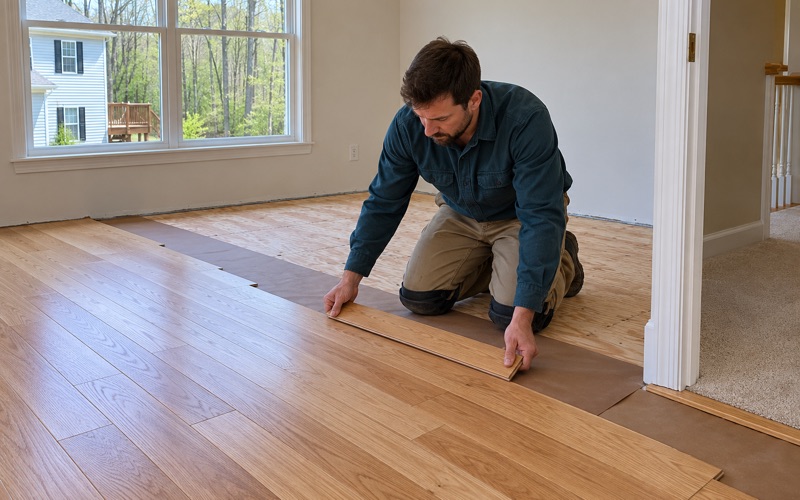
We set the floor’s scope after the source of damage is fixed and the structure has been repaired. Moisture readings are taken again before installation, because wood laid over a damp subfloor will cup or gap as it dries. New boards are given time to acclimate to the house before they go down.
If a project has several rooms, we plan them so the household keeps a usable path through the house. Dust is contained to the rooms we are working in, with doors and returns sealed and HEPA vacuums running, which matters when the family is living at home throughout the work.
Lead, mastic and older surfaces
Homes built before 1978 fall under lead-safe renovation rules, and with a median build year of 1956, many Arbutus houses are in that group. We check the build year and any painted surfaces, including painted floors, thresholds and baseboards, before sanding begins, and work under the EPA RRP Rule where it applies.
Old resilient floor tile and black mastic sometimes turn up under carpet or a later floor. We identify them before anything is sanded and leave their removal to the trade that handles it, so the repair does not turn one problem into a larger one.
Finish choices and household timing
Finish is chosen with the household in mind. Waterborne polyurethane dries faster with less odor, while oil-modified polyurethane cures more slowly and ambers over time. We use finishes that fit Maryland’s VOC limits for wood coatings and plan drying and fume times around when rooms need to be back in use.
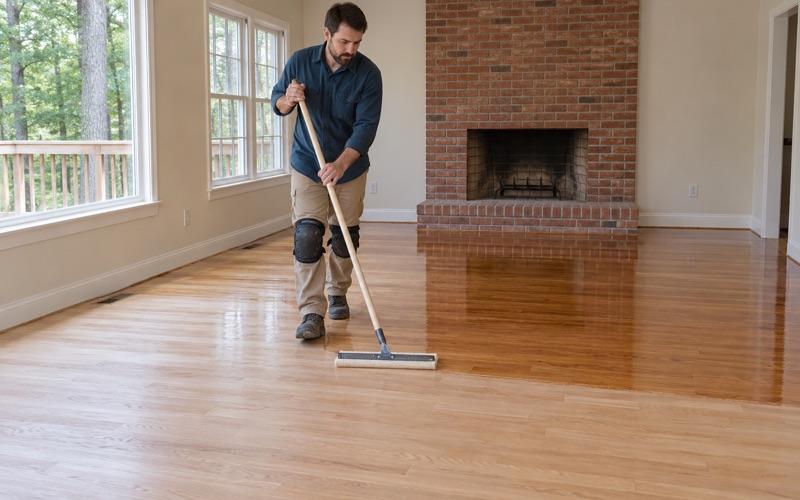
Before any color goes on, we lay stain and sheen samples on the floor itself, beside the repaired section, so the patch and the old boards are matched under the house’s own light. That last step is what makes a repair disappear into the room.
Paperwork to keep
Every job ends with an itemized invoice that matches the estimate, listing materials, areas and work performed. Keep it with the moisture records and photographs; together they show what was found, what was fixed and why.
That file is useful well beyond a loan application. It answers an insurer’s questions after a leak, supports a future sale, and tells the next contractor exactly what is under the finish.
- 20+ Years on Wood Floors
- Written, Itemized Estimates
- Dust Sealed Into the Work Area