
Ellicott City Wood Flooring has handled hardwood stair refinishing in Ellicott City, MD for more than 20 years, serving surrounding cities including Catonsville, Woodlawn, Columbia, Ilchester and Milford Mill. Stairs take more wear than almost any other wood surface in a house, and they are refinished differently from a floor: by hand, one tread at a time, with the risers and nosing treated as separate surfaces.
Because of that, we quote stairs tread by tread rather than by the square foot. The estimate lists treads, risers, nosing, landings and any repairs as separate lines, so you can see where the cost comes from and choose what to include.
Treads, Risers and Nosing
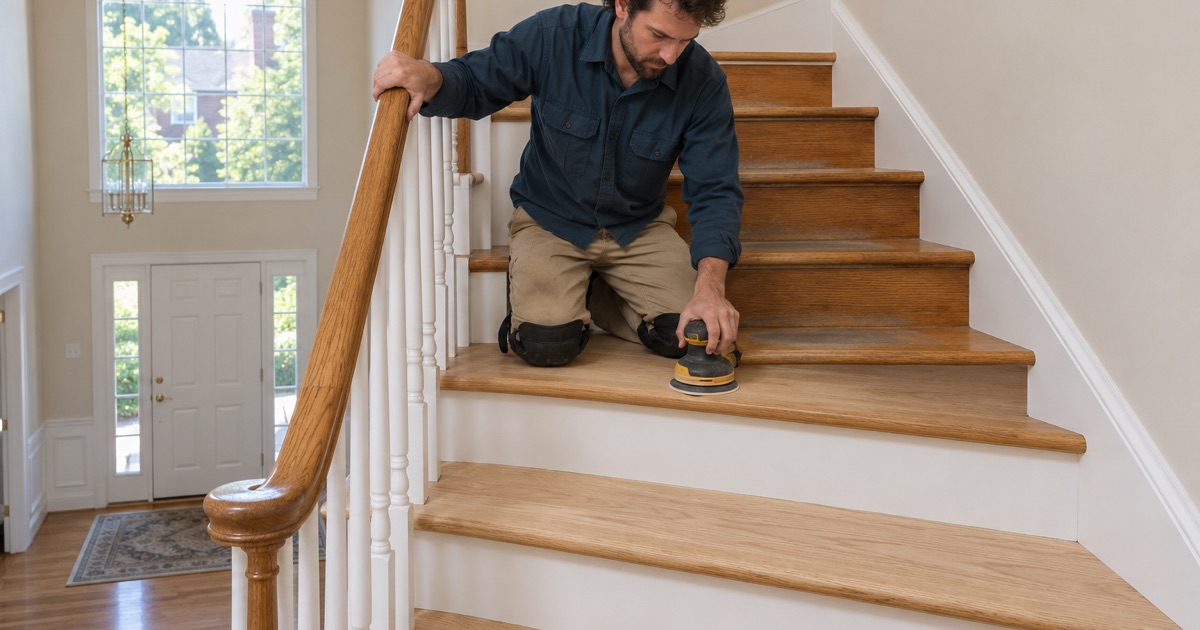
Sanding stair treads by hand
A drum sander cannot reach a stair tread, so each one is sanded with small machines and hand tools, working into the corners against the risers and stringers. The front edge, where feet land, usually carries the deepest wear and needs the most attention.
We remove the old finish down to bare wood, repair cracks and loose treads, and sand through the grit sequence so the stain takes evenly. Skipping that care leaves swirls and dark corners that show every time someone looks up the stairs.
Risers, often painted
Risers on many staircases are painted rather than stained, either from the start or after years of scuffs. They can be repainted crisply, or stripped and finished to match the treads when the wood beneath is good enough.
In a house built before 1978, painted risers and stringers may contain lead. We confirm the build year and look at painted stair parts before any sanding, and plan containment and cleanup under the EPA RRP Rule when they are present.
Stair nosing and return ends
The stair nosing, the rounded front edge of each tread, takes the hardest knocks. Where it is cracked or worn thin, we replace it with new nosing matched to the tread. Return ends on open stairs, where the tread wraps around the side, are sanded and finished as part of the same tread.
Balusters, newel posts and handrails are a separate decision. We protect them while the treads are sanded, and we can refinish or repaint them as their own line in the estimate. Many homeowners keep painted balusters and a stained rail, which frames the refinished treads and keeps the cost of the job focused where the wear actually is.
Converting Carpeted Stairs to Hardwood
What is under the carpet
Pulling carpet off stairs reveals one of two things: hardwood treads that were covered for decades, or rough construction-grade treads that were always meant to be hidden. We lift a corner before quoting so the estimate reflects which you have.
Covered hardwood treads are often in good shape, apart from the tack strip holes and staples along each edge. Those are filled, and the stairs refinish like any other hardwood staircase.
New treads and risers
When the treads underneath are not finish-grade, we replace them with new hardwood stair treads and risers, cut to fit each step. Older staircases are rarely perfectly square, so each tread is measured and fitted individually.
New treads are finished to match the floor at the top and bottom of the stairs. When the floor is also being refinished, we do both together so the color carries from floor to stairs without a visible change.
Finishes and Safety on Stairs
Sheen and grip
Stairs are where a glossy finish becomes a hazard. We usually recommend a satin or matte sheen level, which shows fewer scratches and offers better grip underfoot. Stain and sheen samples go on an actual tread so you can see the result in the stairwell’s own light.
Stairwells are often darker than the rooms around them, lit from a single window or a fixture at the top. A stain that looks right on the living room floor can look nearly black on the stairs, so we test on the tread itself. For households with young children, older adults or dogs, we also talk through runners or individual tread covers.
Durability in the busiest spot in the house
Every trip up and down lands on the same narrow strip of each tread, so stairs need a durable finish. We use an extra coat on treads and choose finishes that fit Maryland’s VOC limits for wood coatings, with drying times planned so the household still has a way up and down.
Waterborne polyurethane suits stairs that need to return to use quickly, while oil-modified polyurethane adds warmth that many people like on older oak. Either way, stairs get the same care as a floor between coats: a light abrasion and a HEPA vacuum pass so grit does not end up locked under the final coat on the surface everyone touches.
Stairs in Townhouses and Split-Levels
Townhouse stairs between three levels
The Ellicott City census area counts more than 5,000 single-family attached homes, and many townhouses stack their rooms over two or three levels. In those houses the stairs are the main route through the home, so we schedule the work to keep one usable path whenever possible, often by finishing alternate treads first.
Townhouse stairs are frequently carpeted from the builder, with hardwood only on the first flight or not at all. Converting them to wood is one of the most common requests we get in attached homes, and we check any association documents for rules on contractors and work hours before the job is scheduled.
Short runs in split-level houses
Split-level houses have several short flights instead of one long one. Each short run still needs its treads, risers and nosing handled individually, and the transitions at each landing have to meet the floors on both levels. We price each run separately so the estimate stays clear.
The lower flight in a split-level often leads to a finished basement or a family room on a slab, where the floor at the bottom may be carpet, tile or engineered wood. We plan the bottom nosing and the transition so the last step meets that floor cleanly, whatever material it is.
- 20+ Years on Wood Floors
- Written, Itemized Estimates
- Dust Sealed Into the Work Area