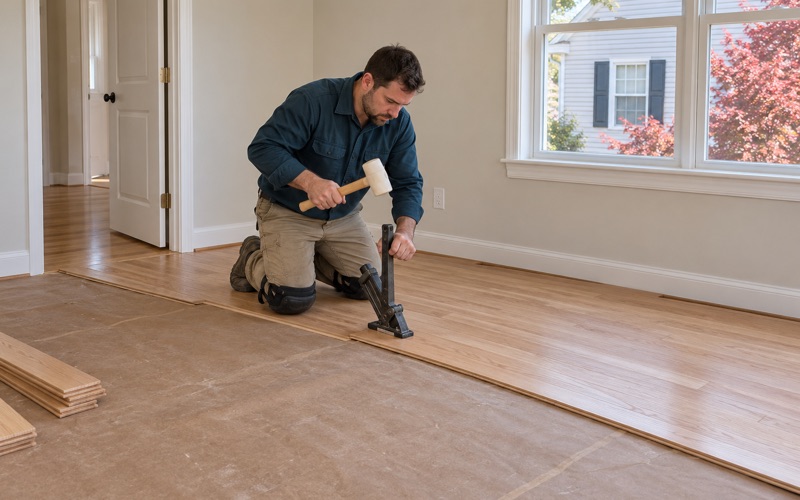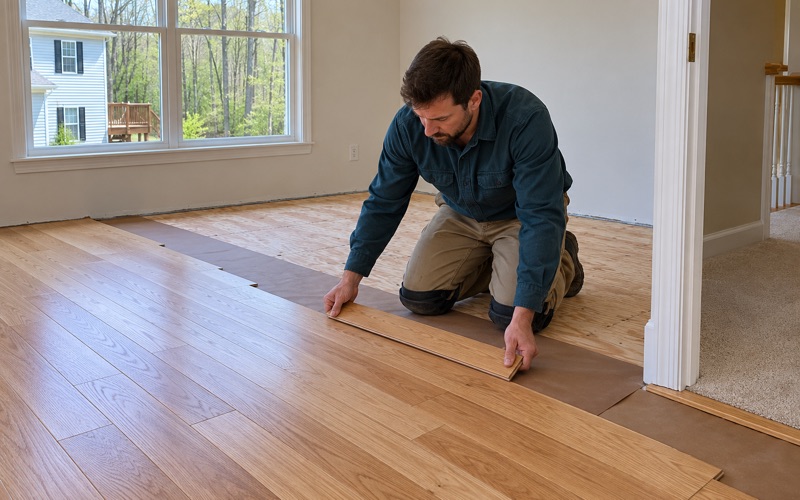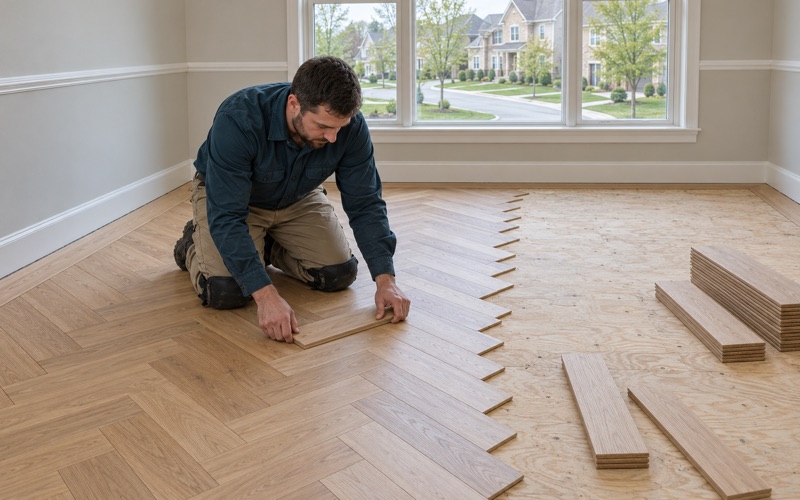
Ellicott City Wood Flooring has spent more than 20 years on wood flooring in Jessup and across central Maryland, and a job here starts with a question most towns never raise: which county does this address answer to? We refinish, repair and install solid hardwood and engineered floors, and we settle the jurisdiction before the first board is sanded.
Most of the houses we see in this community are young enough that the floor itself is rarely the hard part. The harder part is knowing whose permit counter, rental rules and inspection office apply, and building the schedule around that answer instead of discovering it halfway through a project.
Every quote we hand over is written and itemized, room by room, so it can sit in an insurer’s file, a landlord’s records or a closing folder. Stain colors are tested on your own boards before anyone commits to one, and the rooms we work in are sealed off from the rest of the house.
One Jessup Under Howard and Anne Arundel Counties
A Census Place That Crosses a County Line
Jessup is an unincorporated community and census-designated place in Howard and Anne Arundel counties, about 15 miles southwest of Baltimore. It has no town hall of its own, so the offices a homeowner deals with during a renovation belong to county government, and which county depends on the side of the line the house sits on.
The Census Bureau counted 10,535 residents here in 2020, spread across 6.05 square miles. The American Community Survey figures we lean on treat both county portions as a single place, which is useful for describing the housing as a whole but says nothing about any one address.
Where the Mapped Center Falls
The point that marks Jessup on the map sits in Anne Arundel County. The National Weather Service agrees: that coordinate resolves to its Anne Arundel forecast zone, which is the forecast we check when a humid stretch could slow a finish cure. That center point is a convenient reference and nothing more, because it cannot tell us where your home falls.
So we never assume. A mailing address that reads Jessup does not settle the county, and we confirm it from the property record before an estimate turns into a schedule. It takes minutes, and it keeps every later step of the job on the right footing.
Rail, Institutions and a Modest Housing Stock
The community takes its name from Jonathan Jessup, an engineer on the B&O. Much of what outsiders know about it is institutional: the Maryland Food Center, the Clifton T. Perkins Hospital Center dating to 1960, and the Brockbridge Correctional Facility.
None of that changes how a floor is sanded, but it explains why the residential side is smaller than a population count suggests. The homes we actually work in are a compact stock of detached houses, townhouses and apartments spread across both counties.
Looking for wood-flooring closer to Fulton? See Fulton Wood-Flooring.
Which County’s Offices Apply to Your Floor Project
Howard County DILP on the Howard Side
For a house on the Howard side, the office that handles inspections, licenses and permits is the Howard County Department of Inspections, Licenses and Permits, known as DILP. When a project goes beyond refinishing, such as removing a wall that leaves a gap in the floor or reworking a subfloor over a sagging joist, we check with that office what the work calls for before it starts.
DILP is also where a Howard-side landlord’s rental housing license comes from, which matters for the rental work we describe further down. We keep those questions separate from the flooring itself, but we raise them at the first visit so nobody is surprised later.
Anne Arundel County on the Other Side
Homes on the other side of the line fall under Anne Arundel County, whose Department of Inspections and Permits covers that territory. Its rules are its own, and we do not carry Howard’s answers across the county line or assume the two counties match.
When an Anne Arundel-side project touches anything structural, we ask that department directly and write its answer into the job file. The flooring work is the same either way; what changes is the office we call and the paperwork we keep.
Associations and Shared Walls
Jessup’s housing includes 328 attached single-family homes alongside 664 detached houses, and many attached homes sit inside an association with its own renovation rules. We read the governing documents for work hours, noise, deliveries and any underlayment requirement rather than guessing, whichever county the townhouse is in.
Where a townhouse shares a wall or a condo shares a floor, sound-reducing underlayment beneath a new floor is often the item an association watches most closely. We price it in from the start when the documents call for it.
2010s Jessup Homes: What a Floor of That Age Needs
A Young Housing Stock
Of the 1,586 occupied homes the survey counts in Jessup, 716 were built between 2010 and 2019, which is 45.1 percent of the total. Another 54 went up in 2020 or later. That makes this one of the younger housing stocks we work in, and it shapes the calls we get.
A floor laid in the 2010s is now somewhere around 10 to 15 years old. That is usually past the honeymoon and into the first real wear: traffic lanes from the kitchen to the back door, rug shadow where furniture blocked the sun, and a factory finish gone dull down the hall.
Screen and Recoat or a Full Sanding
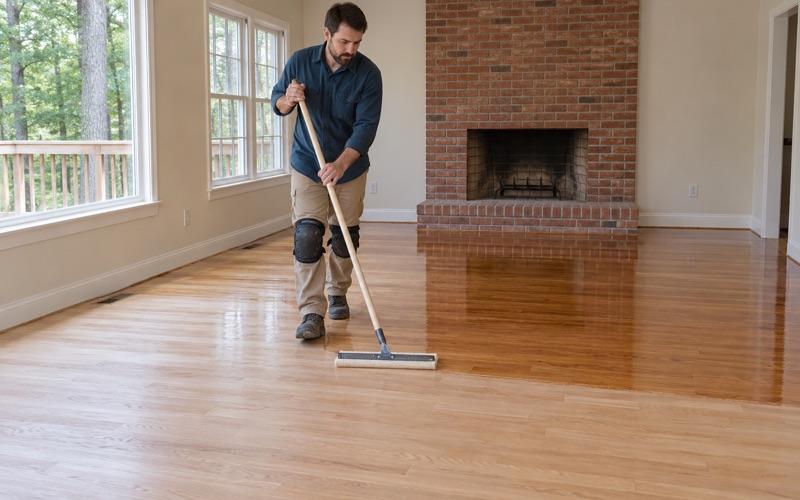
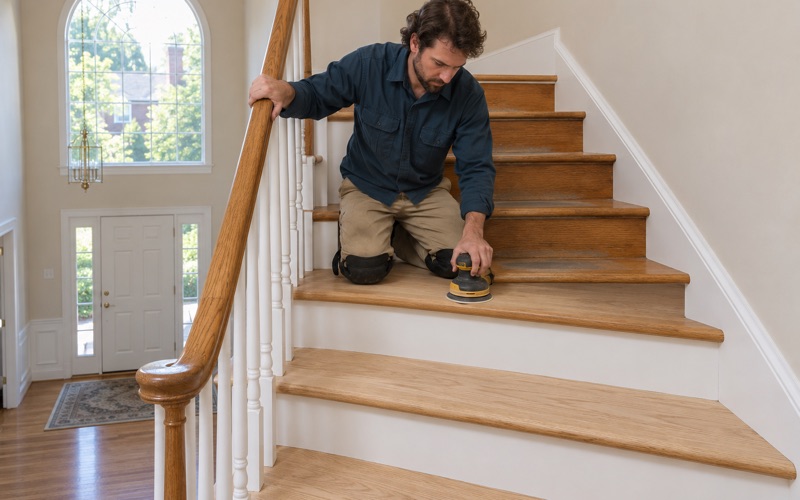
If the wear is still in the finish and not the wood, a screen and recoat is often enough. We abrade the existing coat with an orbital sander, clean up with a HEPA vacuum and lay down fresh waterborne polyurethane, which keeps the original color and skips a full sanding.
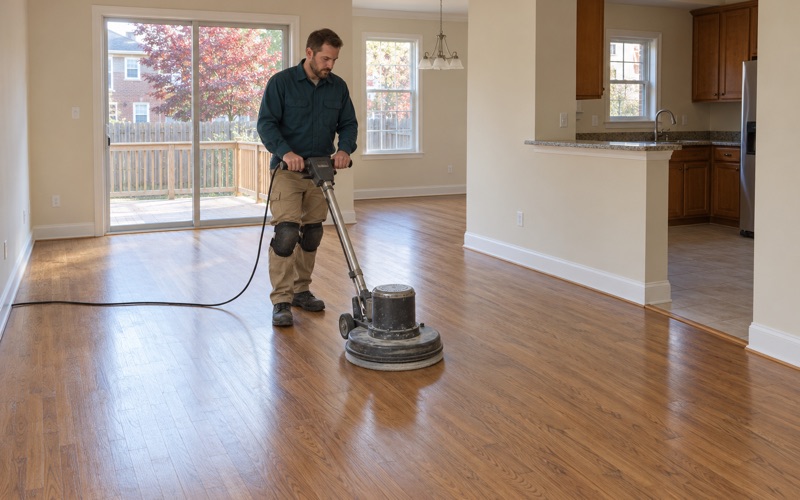
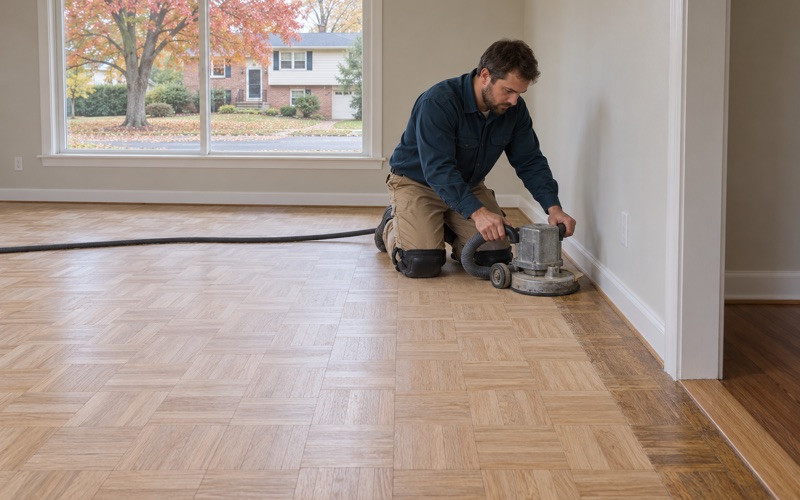
Once bare wood shows through, or pet urine stains and water stains have gone into the boards, the floor needs a drum sander and a full grit sequence. Many floors from this period are prefinished or engineered, and an engineered wear layer can take only so much sanding, so we measure what is left before promising a refinish.
Gaps, Squeaks and Seasonal Movement
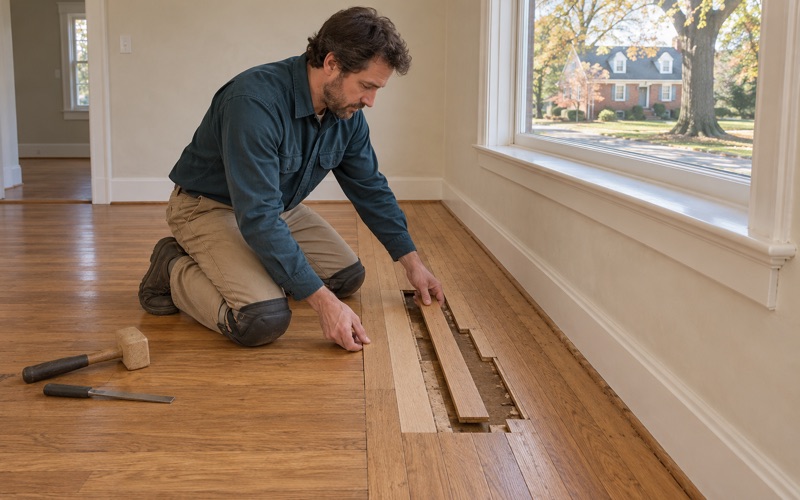
Newer construction brings its own complaints. Winter gaps open between boards when the heat dries the air, and nail pops and squeaky floorboards appear where a subfloor has settled. Much of this is seasonal movement, and we explain which gaps close up in summer before anyone pays to fill them.
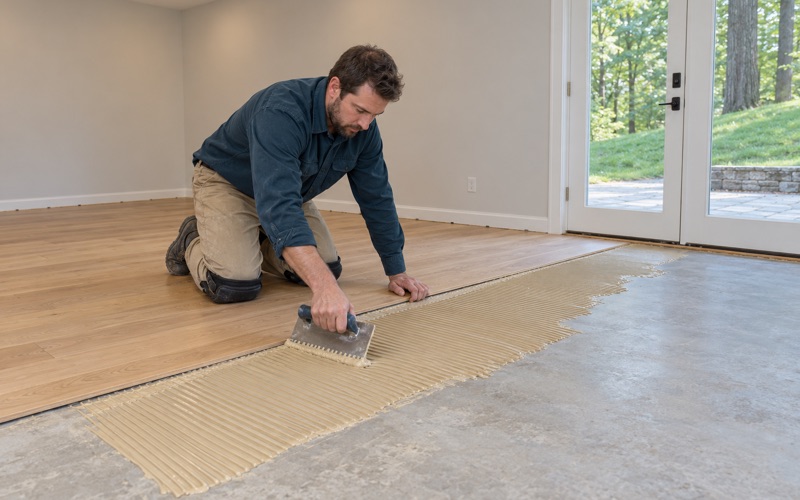
Cupping or crowning is a different signal. It points to moisture, so we take moisture meter readings before treating it as a finish problem, and the same readings come before any wood goes over a concrete slab or into a finished basement, where engineered wood or another floor is often the better call once we have read the moisture and the grade.
Renting and Planning: Confirm the County First
Rental Homes and County Licensing
The survey counts 891 owner-occupied homes and 695 rented ones, so 43.8 percent of Jessup’s homes are rentals. For a landlord, the county line matters twice: once for any permit the work needs, and again for the rental license that comes before a lease is signed.
On the Howard side, DILP issues a rental housing license that has to be in place before a lease and is valid for 2 years. Anne Arundel County keeps its own licensing, and we leave the landlord to confirm with that county what applies to a particular property rather than describing its rules secondhand.
Older Houses and Lead-Safe Work
Not every Jessup home is new. The survey counts 155 built in the 1970s and 192 more from the 1940s through the 1960s, and any house built before 1978 falls under lead-safe renovation rules. We confirm the build year and check painted trim, thresholds and stair risers before a sander enters the room.
In a pre-1978 rental, we time the floor work around the lead dust test Maryland requires each time a tenant changes, so the unit is finished and cleaned ahead of that visit. Old resilient floor tile and black mastic are identified before anything is sanded and left for the trade that handles them.
A Plan That Starts With the Address
Our process here begins with the county, then the house. Once the jurisdiction is confirmed, we walk the floors, take moisture readings, lay stain and sheen samples on your own boards, and price stairs tread by tread, since treads, risers and nosing are never priced by the square foot.
The written estimate lists each room and each step. For a landlord, the final itemized invoice is the kind of supporting documentation Maryland’s security deposit law asks for under Real Property 8-203, and for an owner it is a record worth keeping for an insurer or a future sale.
Finishes are chosen to meet Maryland’s VOC limits for wood coatings, and we plan fume and drying times around whoever is living in the house. Dust stays in the rooms we are working on, with doors and returns sealed until the last coat is down.
- 20+ Years on Wood Floors
- Written, Itemized Estimates
- Dust Sealed Into the Work Area