Ellicott City Wood Flooring has spent more than 20 years on wood flooring in Milford Mill and across Baltimore County, and a large share of that work starts with a call from someone who does not live in the house. A landlord between leases, a property manager holding a move-in date, a tenant asked to price a refinish: the floor is the same oak either way, but the deadline belongs to somebody else.
We sand, screen, repair and refinish solid hardwood and engineered floors, rebuild worn stairs, and patch the gaps left where registers or walls once stood. Before any sanding we confirm the build year and look for painted surfaces, because a home built before 1978 brings lead-safe renovation rules into the job.
What follows is how we plan floor work when the calendar is a lease rather than a holiday, and how that shifts the choice between a light recoat and a full sand down to fresh wood.
Rented Townhouses and the Landlord’s Calendar

Who rents here, and in what kind of house
Milford Mill is a renter-majority community. Census estimates count 6,313 of its 11,773 occupied households in rented homes, which is 53.6 percent, and the split holds even in one-unit attached houses, where 1,569 households rent against 1,293 that own. Centered on Liberty Road and Milford Mill Road and taking in Windsor Mill and Rockdale, it is a place where many of the townhouses we walk into belong to someone with a portfolio rather than someone with a moving van.
That changes who we are talking to. An owner-occupant asks how the floor will look in ten years; a landlord asks whether it will survive the next tenant and be finished before the next lease starts. Both are fair questions, and each answer starts with what the boards and the finish look like today.
Baltimore County’s rental license
Baltimore County requires rental properties with six or fewer units to be registered and licensed, with an inspection by a state-licensed home inspector as part of the process and a lead inspection certificate for units built before 1978. About 2,147 renter households in Milford Mill live in buildings of one to four units, squarely inside that licensing class.
We do not schedule that inspection or speak for it. What we do is fit our work around it: a floor that is finished and cured before the inspector arrives means nobody is stepping around wet coats, and our written record of the job is already in the owner’s file if anyone asks what changed.
Lead dust testing at turnover
Maryland requires a lead dust test at each change of tenant in a pre-1978 rental, and sanding an older floor is exactly the kind of work that has to be behind you before that test is taken. Milford Mill’s housing peaked in the 1970s, with 2,783 units built that decade and another 4,488 built before 1970, so a large share of local rentals sit near or below the 1978 line.
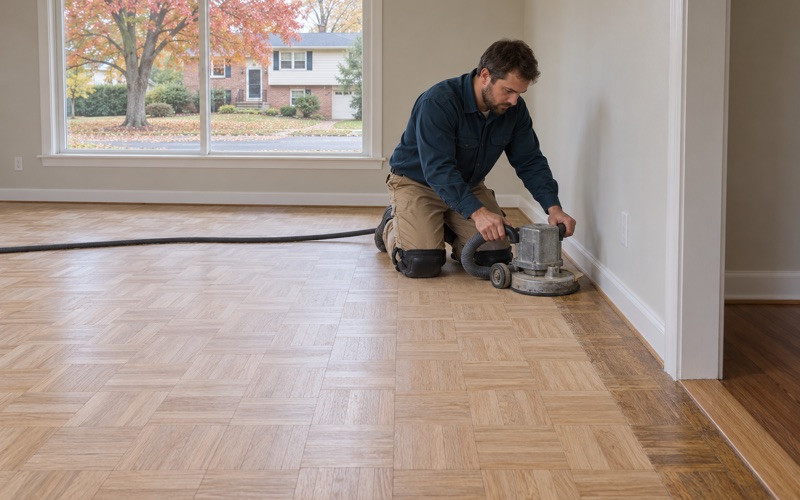
For those homes we put sanding early in the vacancy, contain dust to the rooms being worked on with doors and returns sealed, and finish the cleanup with a HEPA vacuum. The goal is simple: the floor is done and the house is clean before anyone wipes a windowsill for the test.
Looking for wood-flooring closer to Randallstown? See Randallstown Wood-Flooring.
Screen-and-Recoat or a Full Sand Between Tenants
When a recoat is enough
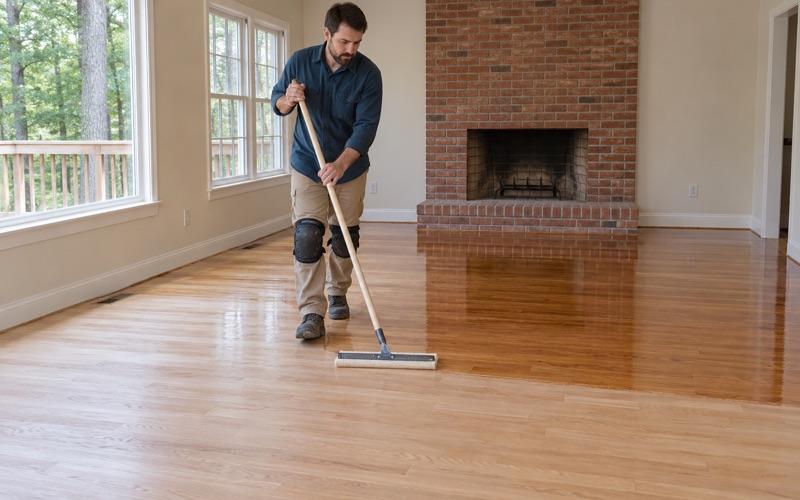
A screen and recoat lightly abrades the existing finish with a buffer and a fine screen, then lays down a fresh coat of polyurethane. It works when the wear is in the finish rather than the wood: dulled traffic lanes, fine scratches, a gray film where the old coat has thinned but still covers the boards. On a steady lease cycle it is often the cheapest way to keep a floor from ever needing the drum sander.
It does not work over wax residue, over some older finishes that refuse to bond, or anywhere the finish has worn through to bare wood. We test adhesion on a small patch before quoting a recoat, because a coat that peels three months into a lease costs the owner more than a full sand would have.
When the floor needs sanding
Pet urine stains, water stains that have turned black, deep gouges from a dragged dresser and peeling polyurethane all sit in or under the finish, and a recoat seals them in rather than removing them. Those floors go through a full grit sequence on a drum sander, get edged and smoothed with an orbital sander, then take stain if wanted and their coats.
Before we commit to a full sand on red oak strip flooring or older narrow strip, we check how much wood remains above the tongue. A floor that has been sanded at turnover after turnover may have one sand left, or none, and a landlord deserves to know that before choosing between a refinish and board replacement.
Choosing a finish for a rental
Waterborne polyurethane dries quickly and carries less odor, which matters when the next tenant’s truck is booked for Saturday. Oil-modified polyurethane builds a warmer amber tone and needs longer before furniture and rugs go back down. Either way, we choose coatings that fit Maryland’s VOC limits for wood finishes and give the owner a firm date for foot traffic, furniture and rugs.
Sheen level matters more in a rental than most owners expect. A satin or matte sheen hides the scuffs a tenant leaves behind; a high gloss shows every one of them at the move-out walkthrough. We lay stain and sheen samples on the floor itself so the choice is made on the real boards under the real light.
Halls, Stairs and Wear Patterns in Rented Townhouses
The front hall and the kitchen path
In an attached house, traffic funnels: front door, hall, kitchen, back door, then up the stairs. Those lanes wear through the finish years before the bedrooms do, and in a rental they get no rest between occupants. When the rest of the floor only needs a recoat, we often spot-sand and rebuild the finish in the lanes first so the sheen reads evenly from wall to wall.
Rug shadow is the other telltale. A tenant’s rug leaves a pale rectangle on oak that has darkened around it, and only sanding brings the room back to one tone. If a landlord wants the floor to look the same for every new tenant, that is usually the turnover to sand rather than screen.
Stairs, quoted tread by tread
A townhouse staircase takes more abuse than any other wood in the house, and it does not refinish like a floor. We price stairs tread by tread, because every stair tread, stair riser and stair nosing is sanded and coated largely by hand rather than run over with a big machine.
Cracked or split treads get replaced rather than filled. A loose nosing is a trip hazard no landlord wants on the record, so we secure it while the stairs are already stripped and open.
Repairs that surface at turnover
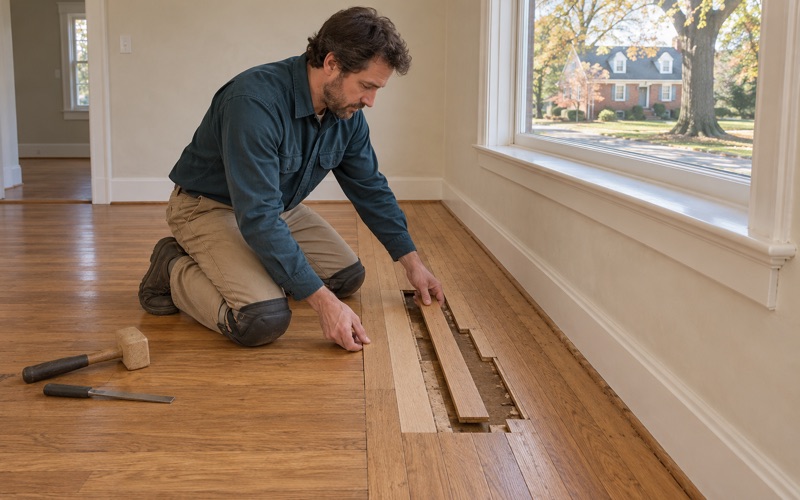
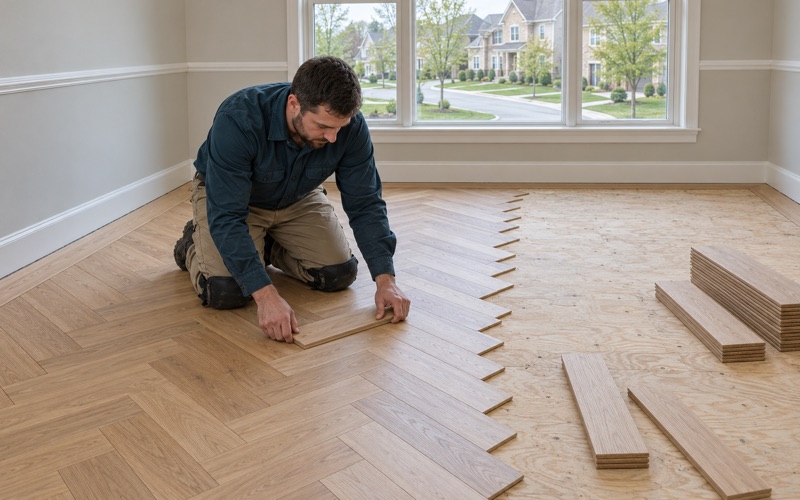
Vacancy is when the damage hidden under furniture comes into view. We find nail pops, squeaky floorboards over a loose subfloor, cupping near a leaking dishwasher, and holes where a floor register was moved or a partition came out. Those holes get patched with boards woven into the existing floor instead of a filler square that reads as a patch from across the room.
Where water caused the damage, we trace it to its source, dry the floor, and take moisture meter readings room by room. If the owner is filing a claim, that record goes to the adjuster along with the estimate, so the repair and the paperwork agree.
Scheduling Floor Work in the Gap Between Leases
Building the vacancy timeline
A recoat in an empty townhouse is usually a short job plus curing time; a full sand, stain and multiple coats takes longer, and stairs add to both. We lay the floor work out against the lease dates as soon as notice is given, so the owner can book the painter, the lead dust test and the licensing inspection in a sensible order.
The order matters. Painting after the floor is coated risks drips and ladder marks on a fresh finish, and sanding after a dust wipe means the wipe was taken in a house that is no longer clean. Our usual sequence is repairs, sanding, finish, cure, and only then the tests and the move-in.
Paperwork for the owner’s file
Every job comes with a written, itemized estimate and an itemized invoice. When part of a security deposit is withheld for floor damage, Maryland’s security deposit law asks the landlord for supporting documentation, and a line-by-line invoice showing which rooms were sanded and which boards were replaced is the kind of record that holds up.
The same paperwork serves an owner who later sells the rental or an insurer reviewing a water claim. We write down what we found, what we did, and what is likely to need attention at the next turnover.
Weather and curing in a vacant house
Milford Mill falls in the National Weather Service’s Southern Baltimore forecast zone, where humidity swings with the seasons. Wood moves with it: winter gaps open between boards when the heat runs, and summer humidity can push a floor toward crowning or buckling if it was finished at the wrong moisture content.
We read the moisture before sanding and plan curing around the conditions in the house. In a vacant rental that often means asking the owner to keep the heat or air conditioning running through the cure rather than shutting the house down until move-in day.
- 20+ Years on Wood Floors
- Written, Itemized Estimates
- Dust Sealed Into the Work Area