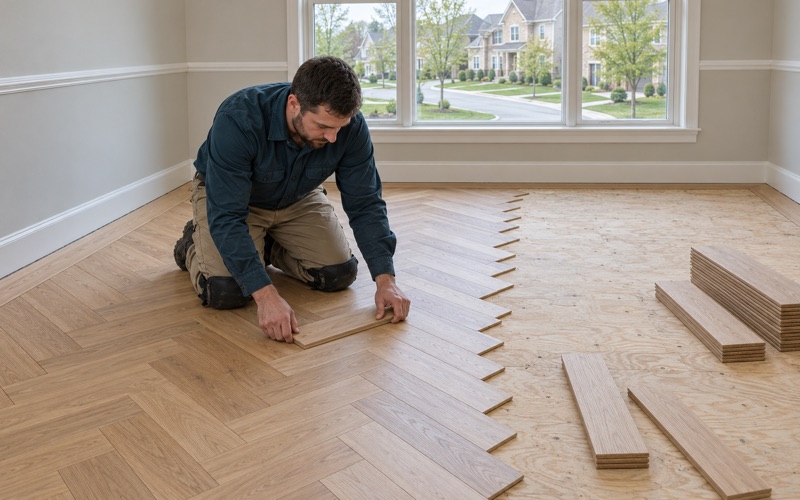
Ellicott City Wood Flooring has done wood-flooring in North Laurel across a good stretch of our 20+ years in the trade, and a large share of those jobs run on a calendar someone else set. A lease ends on a Friday, the next tenant has keys the following week, and the floor in between has to be sanded, repaired or replaced inside that gap. We plan those jobs backward from the move-in date rather than forward from whenever a crew happens to be free.
Owner-occupants call us here too, for the same work they would want anywhere: refinishing worn traffic lanes, replacing boards ruined by pet urine stains, rebuilding a staircase, or putting down new solid hardwood or engineered floors. The difference in this part of Howard County is how often the person paying for the job does not live in the unit, and needs the work finished, documented and out of the way before a tenant arrives.
Every job starts with a written, itemized estimate that a landlord can keep in the unit’s file, and stain and sheen samples laid on the actual floor before a color is chosen. Dust stays in the rooms we are working on, with doors and returns sealed, which matters when the unit shares walls and ductwork chases with neighbors who are still living their normal lives.
A Renter-Heavy Corner of Howard County
Garden Apartments Off Whiskey Bottom Road
Apartment living has deep roots here. In October 1962, 47 acres at the corner of Whiskey Bottom Road and All Saints Road were rezoned for apartments, and the Whiskey Bottom complex that followed changed hands in 1966 for $1,000,000. That rezoning set the pattern for much of the rental housing that came after it in this unincorporated community north of the Patuxent River, which forms the line with Prince George’s County.
The census numbers show how far that pattern carried: 3,325 of 8,827 households here rent, or 37.7 percent, and 1,316 of those renter households live in buildings of 10 to 19 units, the classic garden-apartment size. When a unit in one of those buildings comes to us with tired carpet, we pull back a corner and the tack strip before quoting anything, because what sits under the carpet pad decides whether the job is a refinish, a repair or a new floor.
Townhouses, Older and Newer
Attached homes make up 37.2 percent of the housing here, more than any other single type. Building peaked in the 2000s, when 25.6 percent of today’s homes went up, and in 2006 the Rouse Company developed luxury townhomes at Stone Lake, a former quarry. Many of those townhouses are rented: 694 renter households live in a single-family attached home.
Townhouses from that decade often came with prefinished or engineered floors on the main level, and those need a different first question than an older solid floor does. We measure the engineered wear layer before promising a sanding, because a thin veneer may allow a single careful pass or none at all, and a landlord deserves to know that before choosing between a refinish and a replacement.
Older Units and Lead-Safe Work
Not everything here is new. Census counts put 1,992 homes in North Laurel as built before 1980, including 403 from the 1960s and 268 from the 1950s, and any home built before 1978 falls under lead-safe renovation rules. We confirm the build year and look at painted baseboards, shoe molding and stair risers before a drum sander touches the room.
For rental owners, those older units carry a second step. Maryland requires a lead dust test at each change of tenant in a pre-1978 rental, so we schedule sanding and cleanup to finish before that test rather than after it. Sanding dust that settles on sills the day after a passed test is exactly the kind of timing mistake we plan around.
Looking for wood-flooring closer to Union Square? See Wood-Flooring Services in Union Square.
Howard County’s Rental License and the 2-Year Cycle
A License Before the Lease
Here is the rule every North Laurel landlord works under: the owner of a residential unit must have a rental housing license before entering into a lease with a tenant. Licenses come from the Rental Housing Office of the Howard County Department of Inspections, Licenses and Permits, and the landlord must give the tenant a copy of the license or the application no later than 7 days before the lease term begins.
That matters for flooring because it compresses the end of the turnover. If a floor job is still drying while the paperwork and the move-in are both due, the owner is juggling three deadlines at once. We would rather finish early and leave the unit clean than squeeze the last coat into the final weekend.
Renewal Every 2 Years
A rental housing license is valid for 2 years, and it can be revoked or suspended in between. Before a landlord can get one, the landlord must meet the Howard County Property Maintenance Code for Rental Housing, and DILP’s Inspections and Enforcement Division performs the rental inspections. County guidance notes that occupancy is prohibited until the unit has been inspected and the license approved, with appointments generally available within about 2 weeks.
We do not speak for the inspector, and we do not tell owners what the inspection will or will not look at. DILP publishes a checklist of the most commonly failed items, and a landlord should read it directly. What we can do is make sure our work is finished, cured and cleaned up well before an inspection appointment, so the unit is open and ready when the inspector arrives.
Paperwork That Fits a Landlord’s File
When a departing tenant leaves damage behind, the landlord needs records, not recollections. Our itemized invoice lists each room, the boards replaced, the area sanded, the finish used and the reason for each line, which is the kind of supporting documentation a landlord keeps alongside move-out photos.
The same paperwork helps at the next renewal or at a sale. A dated record showing the living room was fully sanded and finished in a given year, and the hallway screened and recoated a couple of leases later, tells the next buyer or property manager how much life the floor still has.
Turning a Rental Floor Between Tenants
Reading the Floor at Move-Out
We walk a vacant unit the way a tenant lived in it. Traffic lanes run from the entry to the kitchen and from the couch to the hallway, rug shadow outlines where furniture sat for years, water stains darken the boards in front of the sink and the dishwasher, and nail pops or squeaky floorboards show up where the subfloor has moved over a joist.
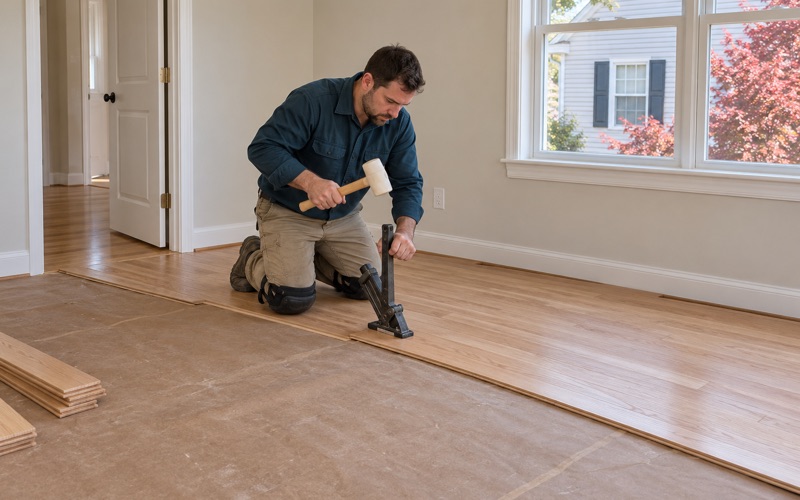
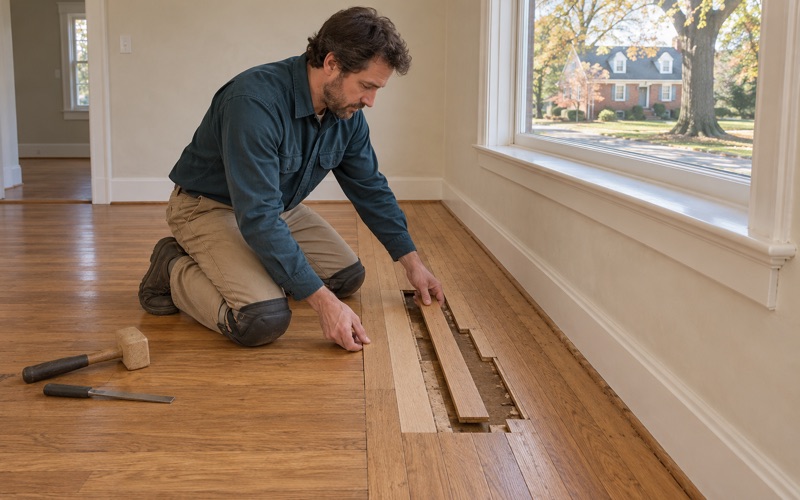
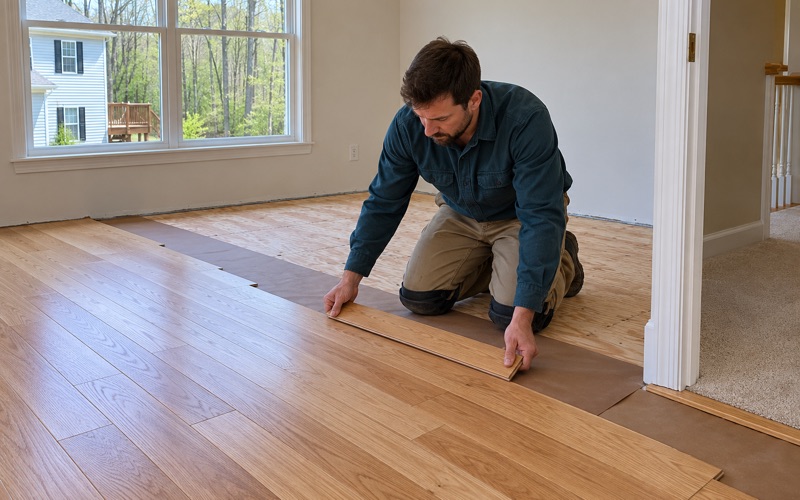
Pet urine stains are the hardest call. A light gray mark may sand out, but a stain that has turned black has usually soaked through the board, and sanding only exposes more of it. Those boards come out, and we weave new tongue and groove boards into the floor so the repair does not read as a square patch once it is finished.
Screen and Recoat or a Full Sand
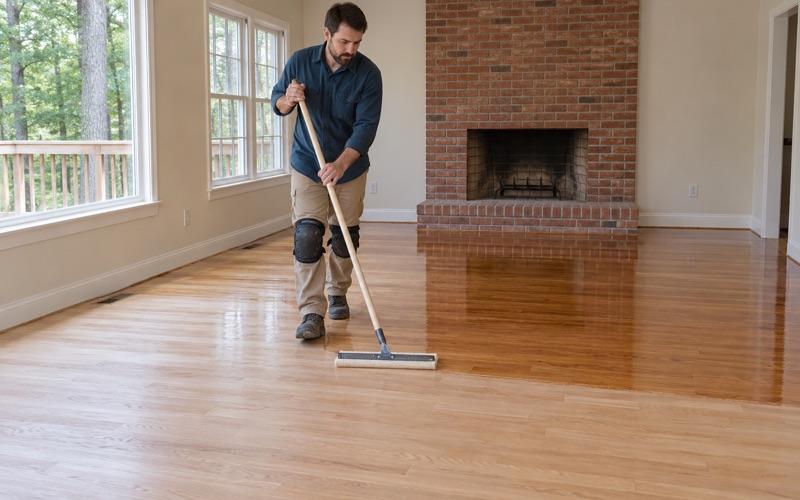
If the finish is scuffed but the wood underneath is still sealed, a screen and recoat is the faster and cheaper turnover. We abrade the existing finish, vacuum, tack and apply a fresh coat, and the unit is usually walkable the next day. It will not remove stains, deep scratches or gray wood where the finish wore through.
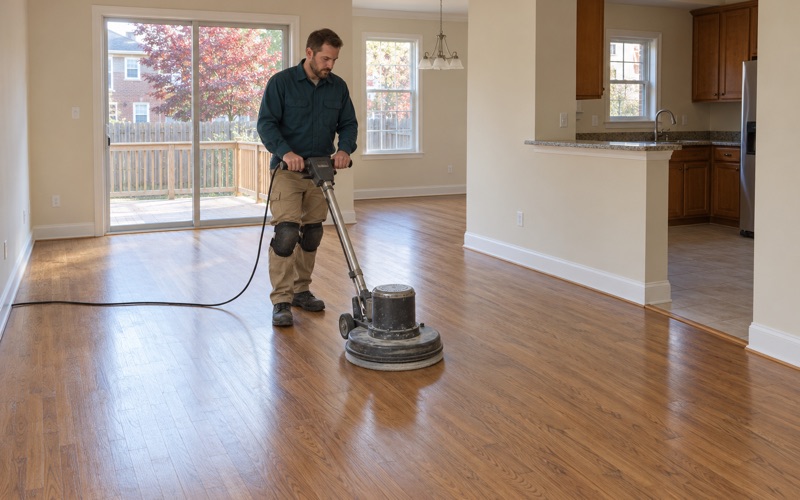
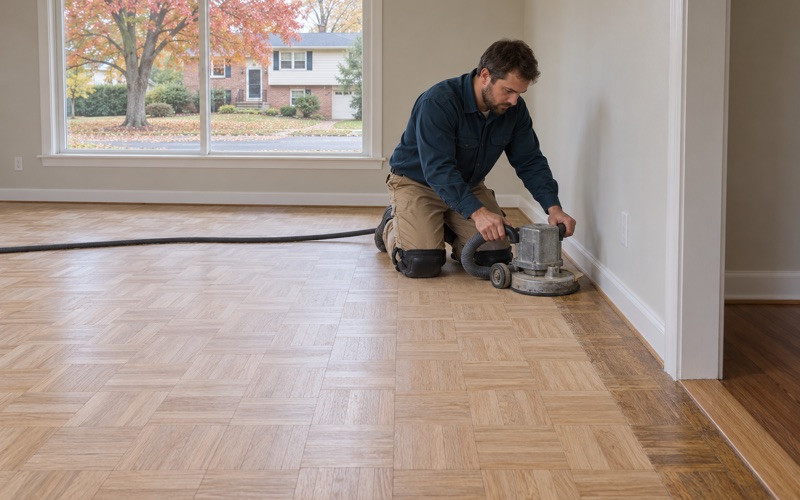
When the floor is past that point, we sand it fully with a drum sander along the boards and an orbital sander at the edges, working through a proper grit sequence. A HEPA vacuum runs behind the sanding, and dust containment keeps the debris inside the unit rather than drifting into a shared stairwell or the neighbor’s side of a townhouse wall.
Finish Timing and the Move-In Date
Most rental turnovers get waterborne polyurethane. It dries quickly, carries little odor, and is chosen to fit Maryland’s VOC limits for wood coatings, which helps when the next tenant arrives within days. Oil-modified polyurethane builds a warmer amber tone, but it needs longer before furniture goes back and gives off more fumes while it cures.
We set the finish choice by working backward from the lease. If the new tenant moves in Saturday, the last coat has to be down early enough for light foot traffic, then heavier furniture, then rugs, which wait the longest. Hardwax oil is an option for owners who want a floor that spot-repairs easily, though it asks more of the tenant in care.
Floors That Hold Up to Tenants in North Laurel
Species, Sheen and Material Choices
For a rented townhouse, durability and repairability matter more than a dramatic look. Red oak strip flooring and white oak both hide everyday wear well and take new boards cleanly, while maple shows scratches more readily. A satin or matte sheen level disguises scuffs far better than gloss, which highlights every scratch a moving dolly leaves behind.
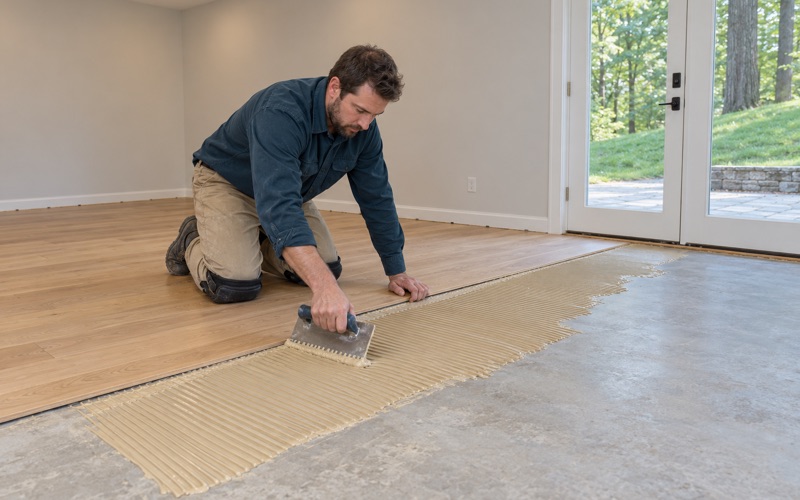
Solid hardwood can be sanded again and again over the life of a rental, which is why we often recommend it on main levels. Engineered wood with a thick wear layer is a sound choice where moisture or height rules out solid, and prefinished boards shorten the time a unit sits empty because no on-site finishing is needed.
Stairs, Lower Levels and Water
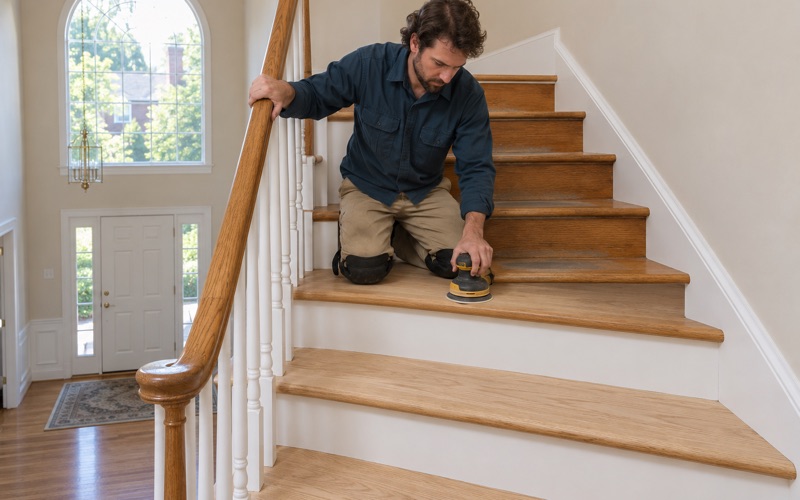
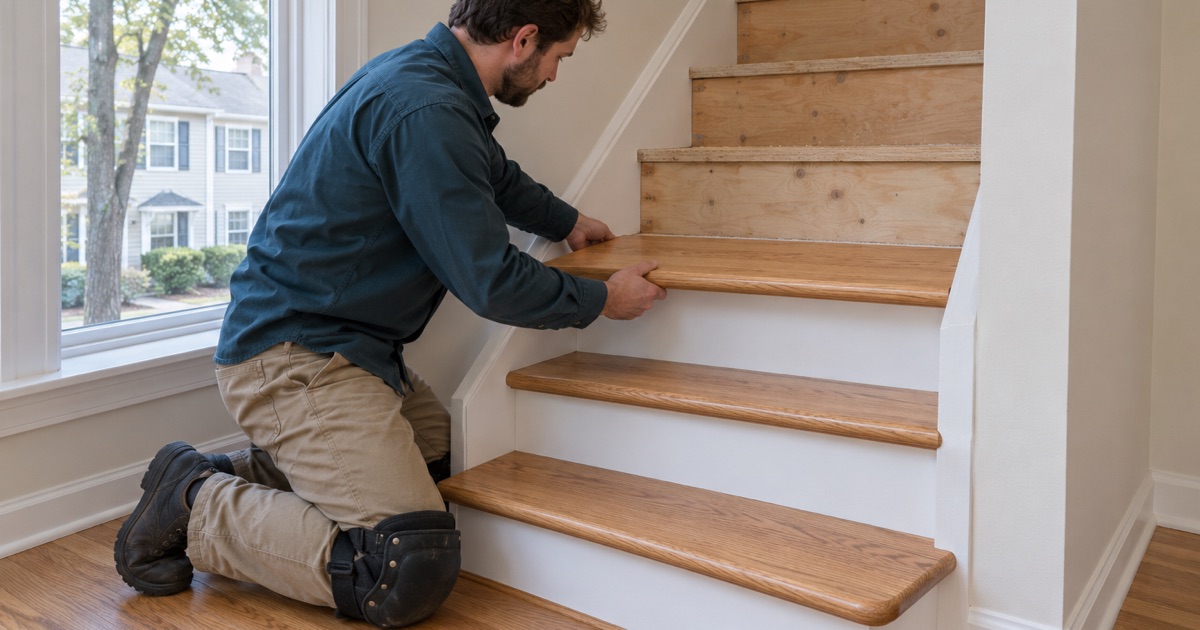
Townhouse stairs take the hardest wear in the unit, and we quote them tread by tread rather than by the square foot, because each tread, riser and stair nosing is its own piece of work. Replacing a few cupped or cracked treads is often enough to make an older staircase pass for new under fresh finish.
For a finished basement, we take moisture readings on the concrete before any wood goes down, and we usually recommend engineered wood or a different floor for below-grade rooms. When a failed sump pump or a burst line leaves cupping or buckling behind, we trace the source, dry the floor, read it with a moisture meter and document the damage room by room for the adjuster.
Association Rules and Shared Walls
Many North Laurel townhouses and condos sit under an association, and their documents can set rules on work hours, contractor parking and sound-reducing underlayment for upper floors. We read those documents rather than assuming, and we plan the job around them so the owner does not hear about a violation from a neighbor.
Before sanding any older unit, we also check for resilient floor tile and black mastic hiding under carpet or vinyl. Those materials are identified and left for the right trade instead of being sanded, and the wood flooring work picks up once that layer has been properly handled.
- 20+ Years on Wood Floors
- Written, Itemized Estimates
- Dust Sealed Into the Work Area