
Ellicott City Wood Flooring has handled parquet floor refinishing in Ellicott City, MD for more than 20 years, serving surrounding cities including Catonsville, Woodlawn, Columbia, Ilchester and Milford Mill. Parquet is one of the most rewarding floors to restore and one of the easiest to ruin, because its small blocks run in several grain directions and a careless sanding cuts across half of them.
We refinish parquet in apartments, condos and houses, reset loose blocks, replace damaged ones and deal with the adhesive question that comes with older parquet. Each job begins by identifying what holds the floor down, because that decides what can safely be done to it. The estimate is written and itemized, with repairs, sanding and finishing listed separately so you can see where the cost lies.
Why Parquet Needs Its Own Approach
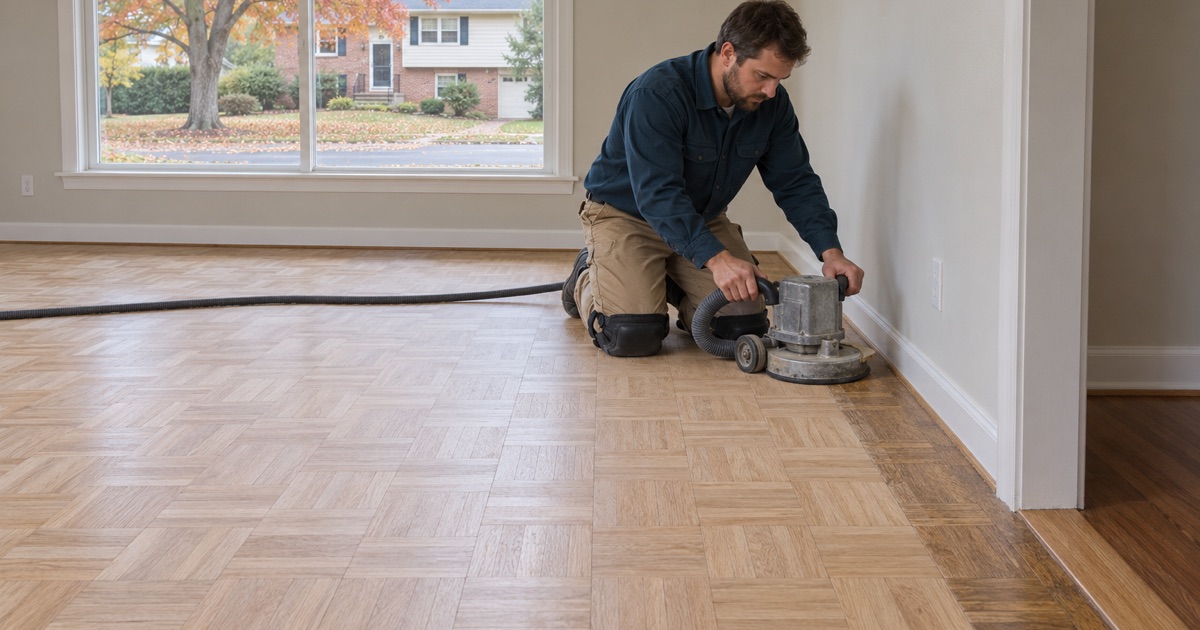
Grain in every direction
A strip floor runs in one direction, so a drum sander can follow the grain down every board. Parquet is assembled from small pieces set in squares, basket weaves or herringbone, so the grain changes direction every few inches. Any machine moving in a straight line is sanding across the grain of some of those pieces.
Cross-grain scratches are nearly invisible in raw wood and very obvious once stain or finish goes on. That is why the sanding sequence on parquet is different, and why the final passes matter so much more than on a strip floor.
Thin blocks and earlier sandings
Many parquet floors are made of thinner blocks than solid strip flooring, and older parquet has often been sanded before. There may be less wood to work with than you expect. We check the thickness at a loose block or an edge before recommending a full sand. When the margin is thin, we sand only as deep as the damage requires, or recommend a screen and recoat that restores the finish without removing wood.
Sanding and Finishing Parquet
A different sanding sequence
We flatten the floor with careful, angled passes, then move to multi-disc or orbital sanders that cut evenly in every direction. Each grit removes the scratches of the one before. The aim is a flat surface with no visible scratch pattern in any block, whichever way the grain runs.
Edges and corners, where parquet often meets a border or a wall, get the same attention by hand. A beautiful center field with swirled edges is a common sign of a rushed parquet job.
Stain and sheen on a patterned floor
Parquet’s changing grain catches light differently from block to block, and stain exaggerates that. A natural finish shows the pattern clearly, while darker stains can make it bolder or flatten it, depending on the wood. We lay stain and sheen samples on the floor itself so you can judge the pattern in your own light.
Lower sheens soften the look and hide wear, while higher sheens emphasize the pattern but show scratches sooner. We usually recommend satin for a balance of both.
Finishes that suit the floor
Waterborne polyurethane keeps lighter woods pale and dries quickly, and oil-modified polyurethane brings out warmth in oak parquet. We use finishes that fit Maryland’s VOC limits for wood coatings and plan coats and drying times around the household.
Parquet has many more joints per square foot than a strip floor, and every joint is a place where finish can pool or pull away. We apply thin, even coats and abrade lightly between them, so the finish bridges the joints without building up ridges along the edges of the blocks.
Repairs Before Refinishing
Resetting loose blocks
Loose parquet blocks click or rock underfoot and catch on vacuums and furniture. We lift them, clean the old adhesive from the block and the subfloor where it is safe to do so, and reset them with a compatible adhesive. The floor is sanded only once every block is firmly down.
Replacing missing or damaged blocks
Blocks that are cracked, burned, stained by pets or water, or missing altogether are replaced with matching pieces. Where an exact match is not available, we can borrow blocks from a closet or under an appliance and put the new ones there, where they will not be noticed.
When loose blocks point to a bigger problem
A few loose blocks are normal in an old floor. Large areas lifting at once usually mean the adhesive has failed or moisture is coming up from below, often from a concrete slab. We take moisture readings before resetting anything, because blocks glued down over a wet slab will lift again.
The Adhesive Question
Black mastic under older parquet
Much older parquet was set in black mastic adhesive, and some of those adhesives contain asbestos. Sanding through to the adhesive or scraping it up can release fibers. We identify the adhesive before any work that would disturb it, and its removal is left to the trade qualified to handle it.
In many cases the parquet can be refinished without touching the mastic at all, provided the blocks are thick enough to sand without reaching the adhesive layer. We confirm that before quoting.
Refinish or remove
When the blocks are sound and well bonded, refinishing is almost always the better choice; it preserves a floor that is hard to replicate today. When the floor is badly damaged, mostly loose, or the adhesive itself is the problem, removal and a new floor may make more sense. We lay out both options with the reasons before you decide.
Parquet in Apartments and Condos
Working in occupied buildings
Parquet is common in older apartment and condo buildings, where work happens above and below neighbors. We seal the unit’s doors and returns, contain dust to the rooms being worked on, and read the building’s or association’s rules on contractor hours and access before scheduling.
Parquet in these buildings often sits directly on a concrete slab, so we read the slab with a moisture meter before resetting loose blocks. Where the building has rules on sound between units, we work within them; refinishing an existing parquet floor rarely changes how much noise reaches the unit below, which is one more reason to restore rather than replace.
- 20+ Years on Wood Floors
- Written, Itemized Estimates
- Dust Sealed Into the Work Area