Ellicott City Wood Flooring handles wood flooring in Scaggsville for homeowners who plan to stay put, and more than 20 years in this trade has taught us that an owner’s floor decision is different from a landlord’s. You are choosing a stain, a sheen and a finish you will walk across every morning, so we treat the estimate as the start of a conversation rather than a price sheet. Sanding, refinishing, stairs, repairs and carpet-to-wood conversions make up most of the work here.
Few of the jobs we see in this corner of the county are emergencies. They are floors that have done their job for a long time and now show it: traffic lanes from the kitchen to the family room, gray boards where the finish wore through, rug shadow where a sofa sat for years, and carpet on stairs nobody has looked under. Each of those has a right order of work, and getting the order wrong costs wood you cannot get back.
Before any machine comes off the truck, we walk the house with you, take moisture readings, check how much sandable wood is left, and lay stain samples on your own boards. You get a written, itemized estimate that lists every room, stair and repair on its own line, so you can decide what to do now and what can wait.
An Owner-Occupied Neighborhood of 1980s and 1990s Houses
Who Signs Off on the Floor
Scaggsville is a neighborhood of owners. The 2024 American Community Survey 5-year estimates count 3,005 of the 3,255 occupied homes in the Scaggsville CDP as owner-occupied, which is 92.3 percent, leaving only 250 renter households. That shapes how a floor project gets decided, because the person approving the stain color is the person who will see it every day.
It also changes what a good job means. A landlord between tenants may want the fastest acceptable result, while an owner usually wants the finish that holds up longest and looks right in their own light. We plan the work around that second goal unless you tell us otherwise.
Detached Houses With Room-by-Room Choices
The same survey counts 2,645 of 3,298 housing units as single-unit detached houses, or 80.2 percent. A detached house gives an owner choices a shared-wall home does not: a whole level can be sanded in one pass, the finish can run continuously from the foyer to the back hall, and stairs, landings and upstairs bedrooms can be tied together in a single color.
Detached houses also tend to collect a mix of flooring types over the years. One room might still have its site-finished hardwood, the next might have carpet over plywood subfloor, and a third might have a prefinished floor someone added later. Sorting that out room by room is the first part of any estimate we write here.
A Build Era Concentrated in the 1980s
The housing stock leans hard toward one era. The ACS counts 1,305 homes built from 1980 through 1989, or 39.6 percent of the total, plus 721 from 1990 through 1999, so 61.4 percent of Scaggsville homes date to those 2 decades.
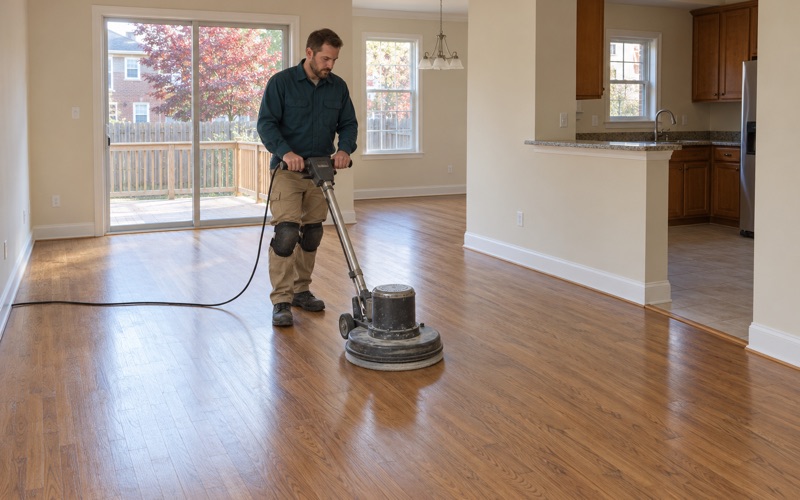
For floors, that means much of the hardwood in the neighborhood has been in service since before 2000. Some of it has been screened and recoated along the way, some has never been touched, and a lot of it is reaching the point where another recoat no longer hides the wear. That first full sand and refinish is where we spend most of our time in Scaggsville.
Looking for wood-flooring closer to Sykesville? See Wood-Flooring Services in Sykesville.
The First Full Sanding, and the Stairs That Come With It
Reading the Floor Before the Drum Sander
A floor that has never been fully sanded usually has plenty of wood above the tongue, but we still check before we start. We pull a floor register or look at a threshold edge to see the board profile, note any face nails sitting high, and mark nail pops and squeaky floorboards so they can be fastened before the drum sander touches them.
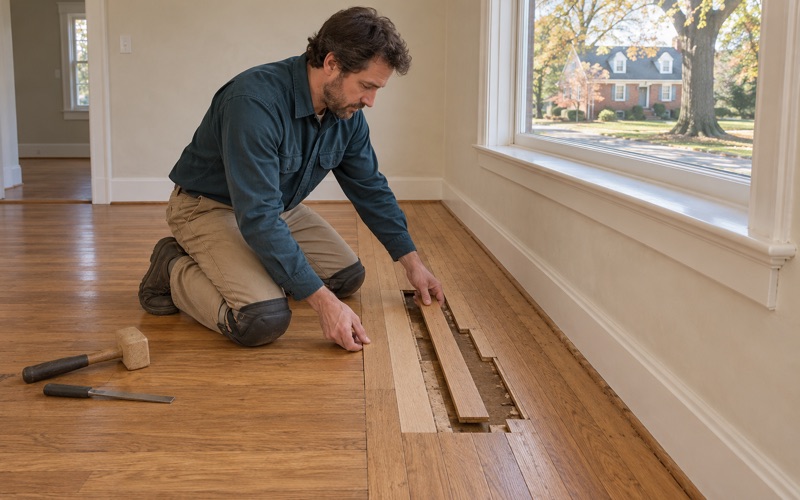
We also look at what the years have done to the surface. Pet urine stains, water stains near patio doors and sinks, and wax residue from old cleaning products all change the plan. Light marks sand out, while deep pet stains usually call for board replacement, with new boards woven into the floor so the repair disappears.
Grit Sequence, Stain and Sheen
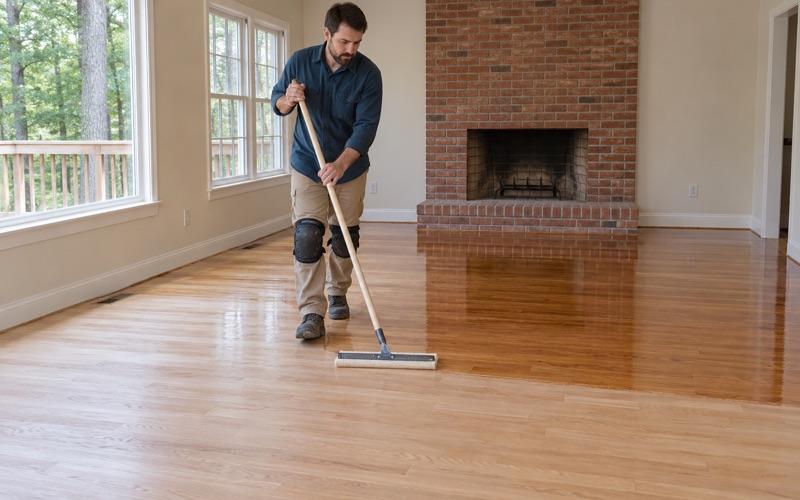
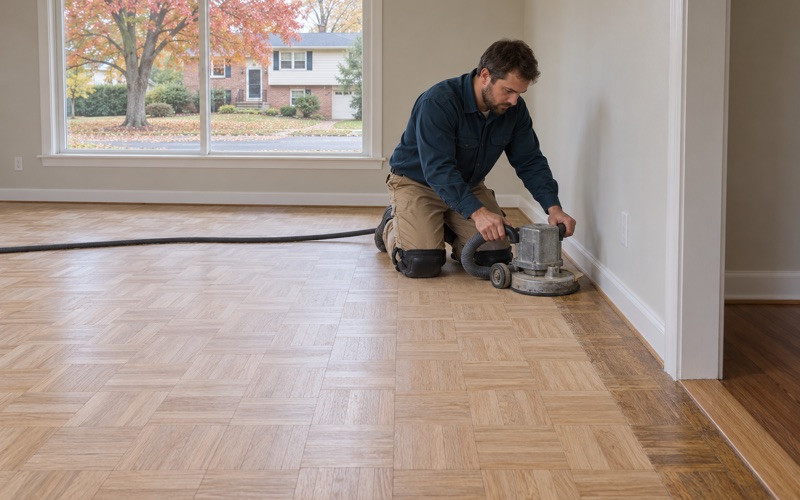
The grit sequence on a first sanding is about removing the old finish and flattening the boards without taking more wood than the floor needs to give. We run the drum sander with the grain, edge the perimeter, and finish with an orbital sander so swirl marks do not show under stain. Between passes the floor gets a HEPA vacuum so the next grit cuts wood, not dust.
If your floor is red oak strip flooring, the old finish has likely ambered toward the orange oak tone many owners want to move away from. A fresh sanding opens up the choice: natural, a gray or brown stain, or something darker. We lay stain and sheen samples on your boards in your own light, because a color that looks right on a sample board can read very differently across a whole room.
Carpeted Stairs in a Two-Story House
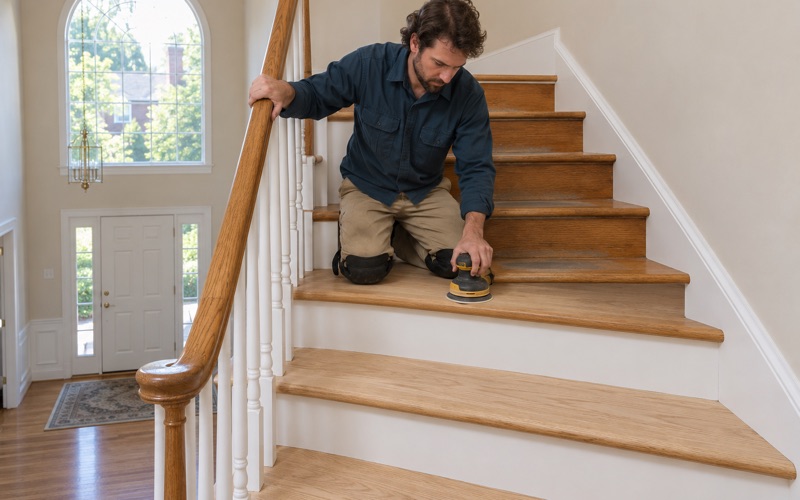
Plenty of houses from this era came with carpet on the stairs, and owners who refinish the main floor often want the staircase to match. What sits under that carpet varies. Sometimes it is finished oak treads; sometimes it is paint-grade treads and risers meant only to hold carpet, with tack strip and staple holes in every step.
We quote stairs tread by tread, because a staircase is not a square-foot job. Each tread is judged on whether it can be sanded and stained, or whether new stair treads, stair risers and stair nosing make more sense than trying to make construction-grade wood look like furniture. The estimate shows that choice for every step.
Pulling Carpet and Living at Home During the Work
Carpet-to-Wood Rooms
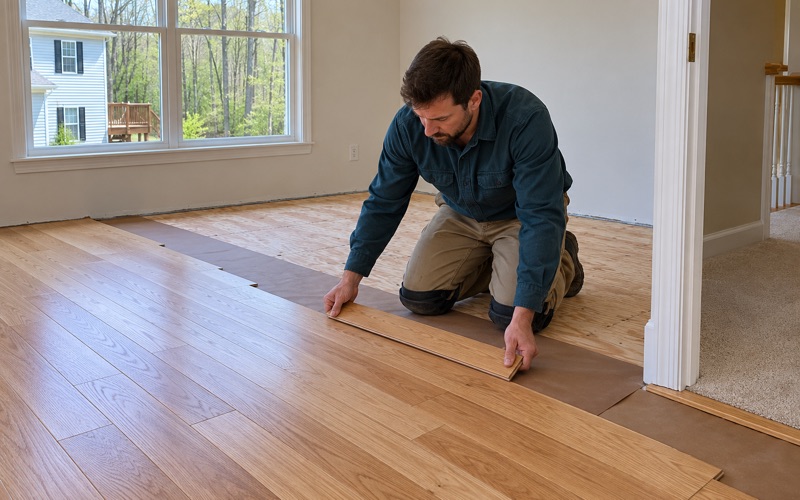
Bedrooms and family rooms in houses of this age were often carpeted from the start, so a carpet-to-wood project usually turns out one of 2 ways. Either there is hardwood under the carpet pad that has never seen foot traffic, or there is bare plywood subfloor and a new floor has to be installed.
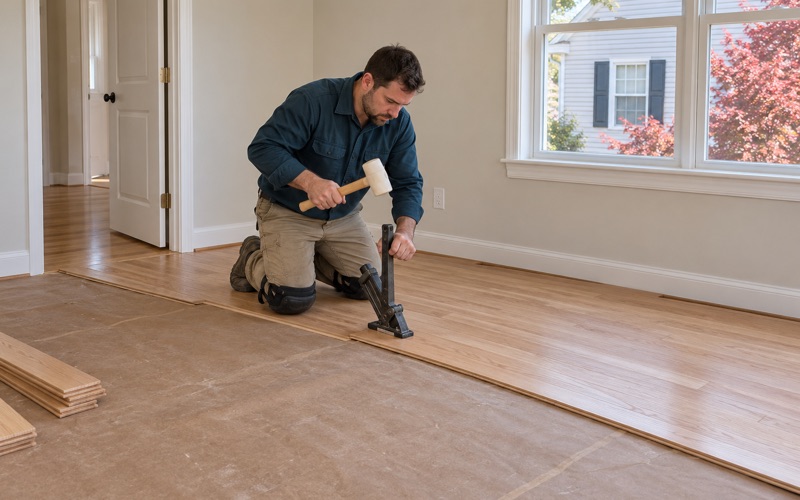
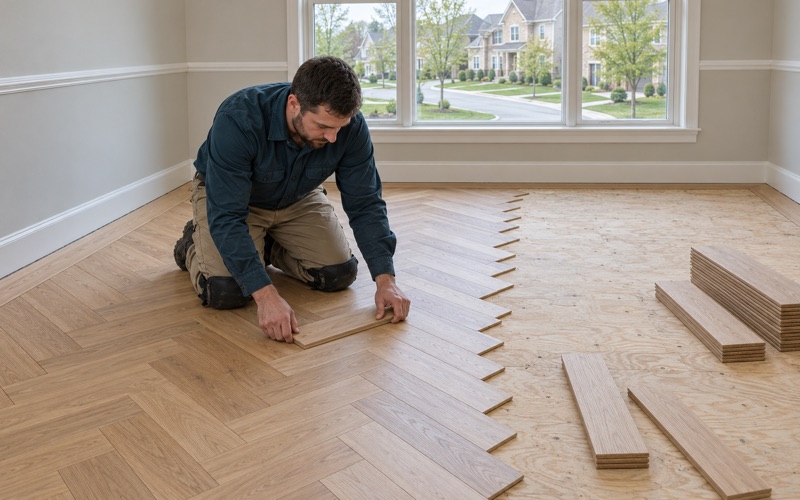
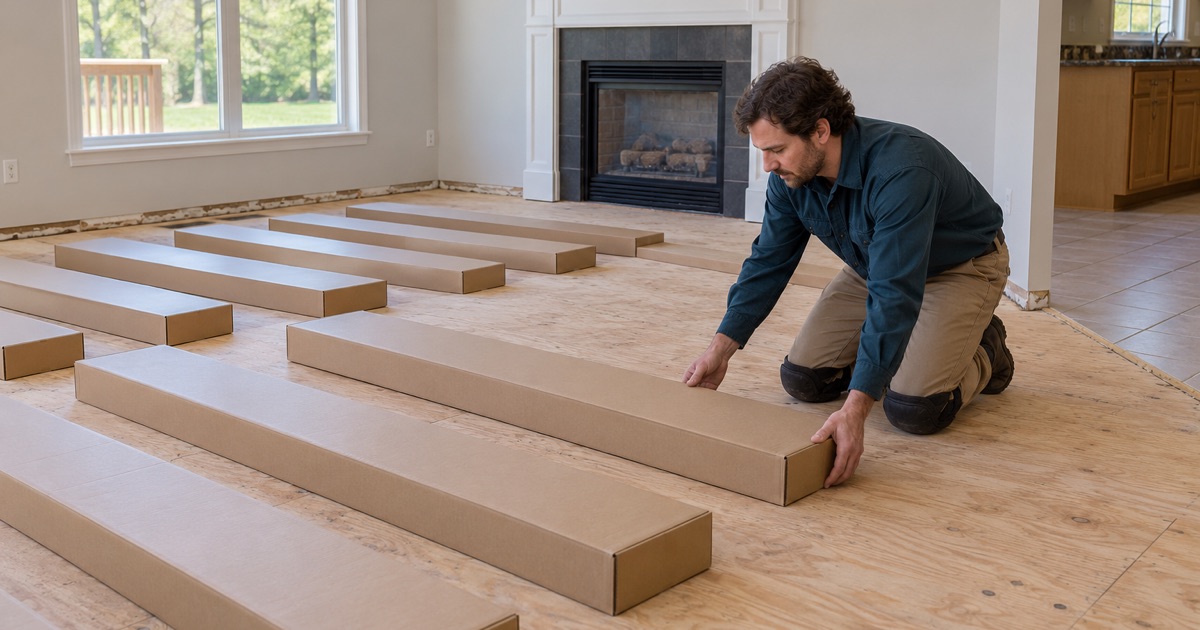
When hardwood is there, it often looks better than the exposed rooms because it never wore, and it can be sanded to match. When it is subfloor, we check for squeaks and loose spots over each joist, take moisture readings, give the new boards time for acclimation, and install solid hardwood with flooring cleats so the room can be finished with the rest of the house in one continuous color.
Dust Containment and Room Sequencing
Owners in detached houses usually stay home during a refinish, so we plan the order of rooms around how you actually live. Bedrooms can run on one schedule and the kitchen path on another, so there is always a way in and out and somewhere to sleep.
Dust containment is part of every job. Doors and HVAC returns in the work area are sealed, the sanders run with dust collection, and we clean with a HEPA vacuum before any finish goes down. The rooms we are not working in stay usable from start to finish.
Finish Choice and Drying Times
Finish choice decides how long you are out of a room. Waterborne polyurethane dries faster with less odor, oil-modified polyurethane ambers more and needs longer before furniture goes back, and hardwax oil gives a low-sheen, spot-repairable surface that suits some households better than a hard film. We choose products that fit Maryland’s VOC limits for wood coatings under COMAR 26.11.39 and plan fume and drying times around who is in the house.
Seasonal moisture matters too. Scaggsville falls in the National Weather Service’s Central and Southeast Howard forecast zone, and like anywhere in Maryland, heated winter air and humid summer air move wood. We read the floor’s moisture before finishing, so winter gaps and mild summer cupping are understood as seasonal movement rather than mistaken for a failed job.
Planning a Floor You Will Live With for Decades
Repairs Before Refinishing
Long-held houses collect small changes: a wall opened between the kitchen and family room, a floor register moved, a built-in removed. Each leaves a gap or a mismatched patch in the floor. We repair those spots with boards woven into the existing floor rather than a strip laid across the grain, so the fix disappears once everything is sanded and finished together.
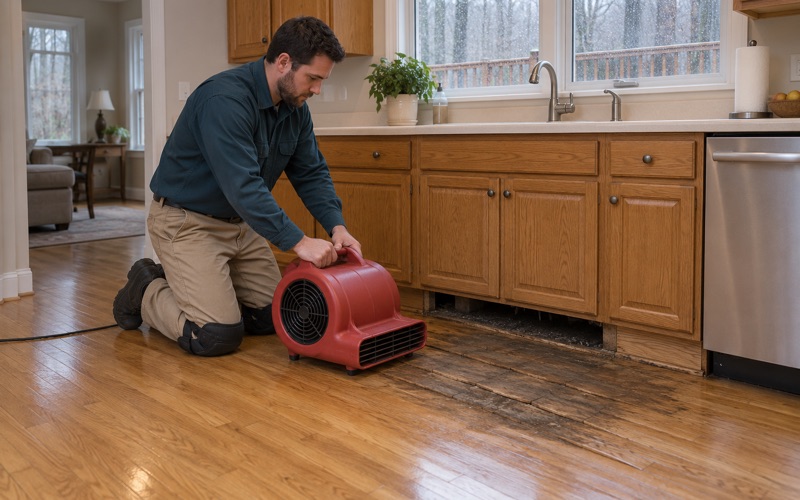
Water damage is another common find around dishwashers, refrigerators and back doors. We trace the source, dry the area, confirm it with a moisture meter, and document each affected room if an insurance adjuster is involved. Cupping, crowning and buckling each say something different about where the water came from and how long it sat.
Older Homes and the Few Rentals
Not every house here is from the 1980s or 1990s. The ACS still counts 216 homes from the 1970s and 189 from the 1960s, with a smaller number older than that. For any home built before 1978, we check the build year and any painted surfaces before sanding, because that work falls under lead-safe renovation rules.
With only 250 renter households in the CDP, rentals are a small part of the picture, but they get the same care. For a pre-1978 rental, we schedule floor work around the lead dust test Maryland requires at each change of tenant, and Howard County’s DILP issues the rental housing license a lease needs. Our itemized invoice also gives a landlord the documentation Maryland’s security deposit law asks for.
From Route 216 to the Patuxent
The Scaggs family settled 700 acres here in the 1830s, and the land is now mostly residences with some commercial establishments. From the houses near MD Route 216, which runs through the center of Scaggsville, down to the Patuxent River that forms the southern edge and the Howard County line, owners bring us the same core questions: which rooms first, whether the stairs should match, and which finish will still look right years from now.
The answers differ from house to house, so every owner gets a written, itemized estimate to keep with the house records for an insurer or an eventual sale. It lists each room, each stair tread and each repair separately, so the project can be done all at once or in stages without losing track of what was agreed.
- 20+ Years on Wood Floors
- Written, Itemized Estimates
- Dust Sealed Into the Work Area