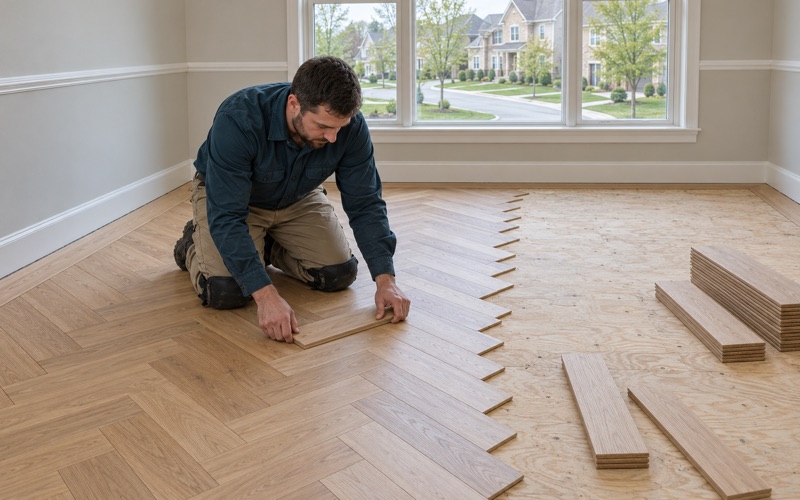
Ellicott City Wood Flooring has spent more than 20 years on wood-flooring in Union Square and the rest of the Baltimore area, and much of the work on these blocks is a narrow kind of job: getting an old rental floor sound, smooth and finished between one lease and the next. We sand worn strip floors, weave in new boards where old ones failed, rebuild stair treads and recoat finishes that a busy household has walked down to bare wood.
Most of the floors we see here belong to landlords working against a calendar. A tenant moves out, a license renewal or a lead certification date sits a few weeks away, and the floor has to be finished and cured before anyone carries furniture back in. We plan the job backward from that date rather than squeezing it into whatever gap is left.
Owner-occupants call us too, usually for the same reasons with less of a deadline. Whoever is paying, we start the same way: by reading the house, the build year and what is actually under the carpet before we quote a single room.
Old Brick Rowhouses and the People Who Rent Them
Italianate fronts, pine and oak behind them
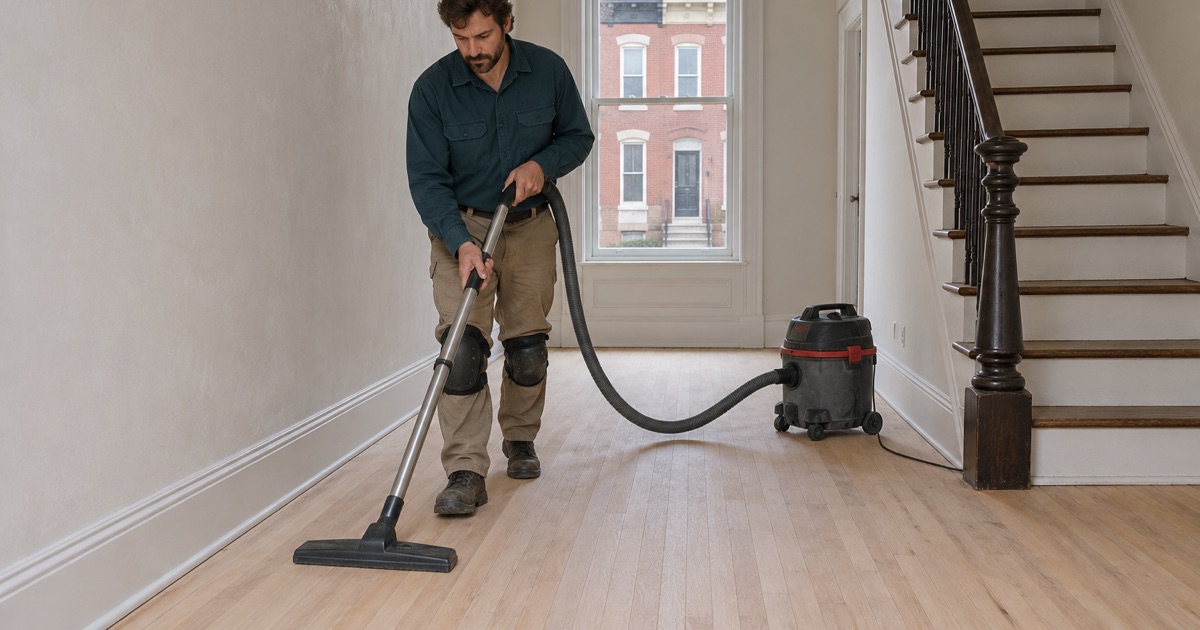
Union Square is a Baltimore City neighborhood in the Sowebo area that dates to the 1830s, built up around Union Square Park, which dates from 1847. Most of the rowhouses facing it are pre- and post-Civil War Italianate brick, with Early Victorian Greek Revival and Late Victorian Romanesque Revival fronts mixed in. Behind those facades, we typically find heart pine or narrow red oak strip flooring nailed across the joists, often under a layer or two of later carpet.
That age matters for the sanding plan. Across the Southwest Baltimore Community Statistical Area, which the Census figures cover rather than the square by itself, 5,340 of 8,736 housing units were built in 1939 or earlier. A floor that old has usually been sanded before, so we pull a floor register or a threshold and check how much wood remains above the tongue before a drum sander touches it.
A renter-heavy district
The same ACS 2024 five-year figures count 3,660 of the area’s 5,410 occupied units as renter-occupied, or 67.7 percent. Most of the housing is attached, which means the typical floor job here is a rowhouse with a front room, a middle room, a narrow stair and bedrooms above. Turnover is constant, and so is the wear pattern it leaves.
We see the same set of problems again and again in these rentals: traffic lanes worn gray down the middle of each room, pet urine stains near the back door, water stains around radiators, and rug shadow where a tenant’s furniture sat for years. None of it is unusual for a rental floor, and most of it is fixable without replacing the whole room.
What the age of the house means for sanding
A house this old was almost certainly painted with lead-based paint at some point, and that paint often ends up on baseboards, shoe molding, stair risers and the edges of the floor itself. Before we sand, we note the build year and look at every painted surface the sanding and edging will reach, because homes built before 1978 fall under lead-safe renovation rules.
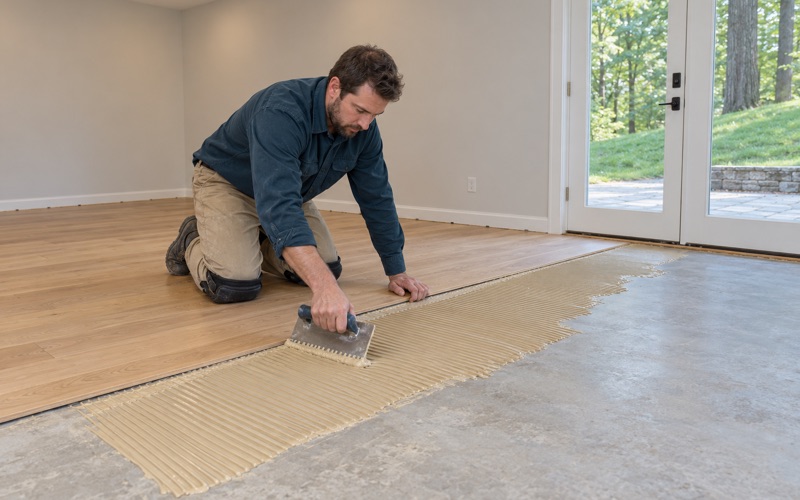
We also look under the carpet for old resilient floor tile and black mastic, which turns up in kitchens and back rooms of rowhouses remodeled mid-century. When we find either, we stop and leave it for the trade that handles it, rather than running a sander over material we have not identified.
Looking for wood-flooring closer to Pikesville? See Pikesville Wood-Flooring.
Rental Licensing and Lead Certification in Baltimore City
The license every rental needs
Baltimore City is an independent city with no connection to Baltimore County, and Union Square has no local government of its own, so the rules that apply to a rental here come from the city. The Department of Housing and Community Development states that all non-owner-occupied properties used as rentals must be licensed to operate as a rental. That applies to a single rowhouse with one tenant just as much as a building with many units.
Part of that license application is a passing inspection report from a third-party inspector licensed by the state and registered with the city. New and initial rental licenses are issued for 2 years, and property registration runs January through December with fees paid every year. Those dates are fixed on the landlord’s side, and they are often what sets the deadline we work toward.
Lead certification, unit by unit
The same application asks landlords to submit current lead certification information for each unit in the property. The certification itself is a Maryland matter, handled by the Maryland Department of the Environment through its Reduction of Lead Risk in Housing program. A floor contractor does not issue it, and we do not hold ourselves out as doing so.
The Maryland lead law used to cover a narrower set of older rentals. House Bill 644 of 2012 expanded it to include rental properties built before 1978, the year lead paint was prohibited nationally, and that change took effect January 1, 2015. With so much of this housing stock built well before then, nearly every rental rowhouse we work in falls inside it.
Where floor work fits in
Refinishing a floor is not part of what the license or the certification asks for, and we will not tell a landlord otherwise. What matters to us is timing. Fresh sanding, new finish and replaced boards are all work done inside a pre-1978 unit, so we schedule rental floors around the lead certification the unit needs before the next tenant arrives, with the floor finished, cured and cleaned up well ahead of that date.
On the permit side, the Baltimore City Building Code’s 2024 edition lists interior finish work such as painting, tiling, carpeting and cabinets as exempt from a permit, but it does not name wood flooring specifically. When a job goes beyond the surface, such as replacing a damaged subfloor or a section of joist, we tell the owner so the question can be asked of DHCD Permits and Inspections before the work starts.
Turnover Floors: Sanding, Recoating and Board Repair
Full sand or screen and recoat
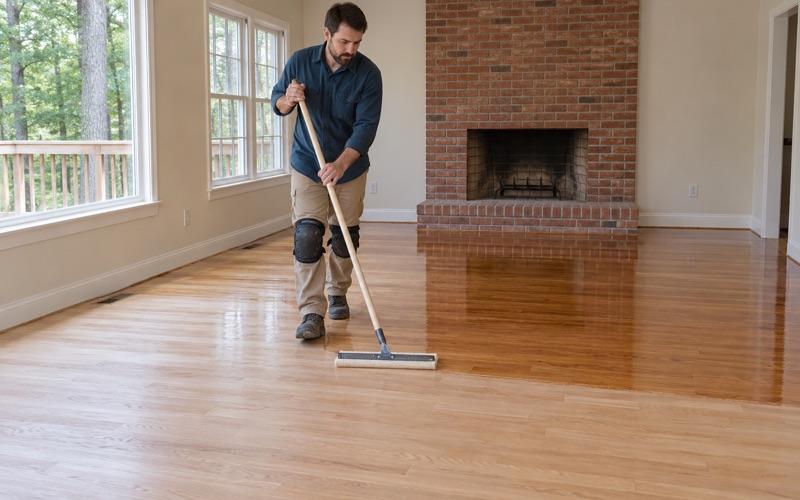
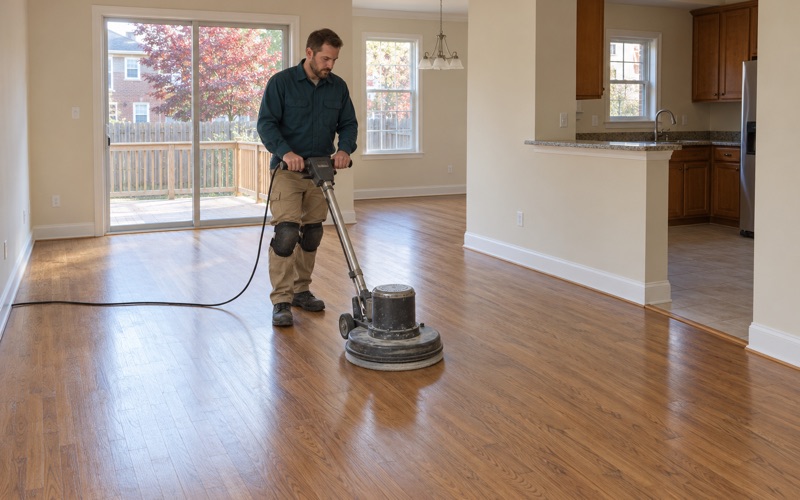
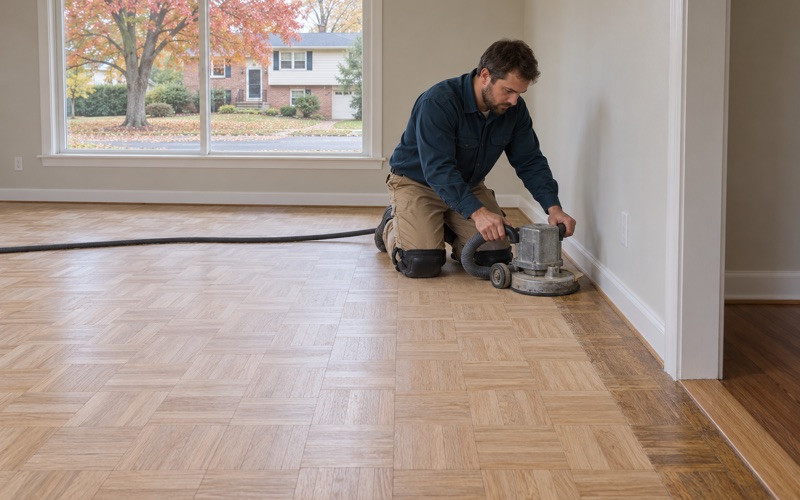
Not every turnover needs a full sand. If the finish is dull and scuffed but still intact, a screen and recoat lightly abrades the existing coat and lays a fresh one over it, which takes far less time and removes almost no wood. When the finish is peeling polyurethane, the traffic lanes are down to bare wood or there are deep pet stains, we move to a full sanding with a drum sander and an orbital sander through a proper grit sequence.
For most landlords we recommend a waterborne polyurethane, chosen to fit Maryland’s VOC limits for wood coatings, because it dries quickly and lets the unit get back on the market sooner. An oil-modified polyurethane is still an option where the owner wants its warmer tone on old pine. Either way, we give a realistic drying and cure time so the move-in date is not a guess.
Weaving in boards where radiators and walls came out
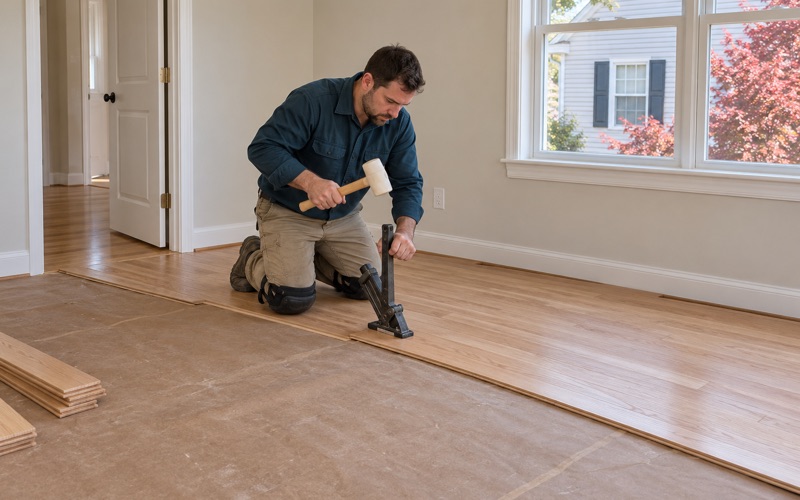
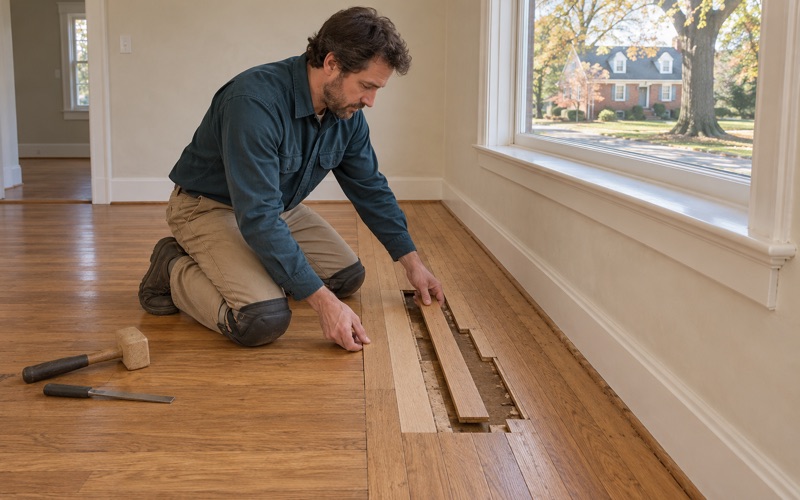
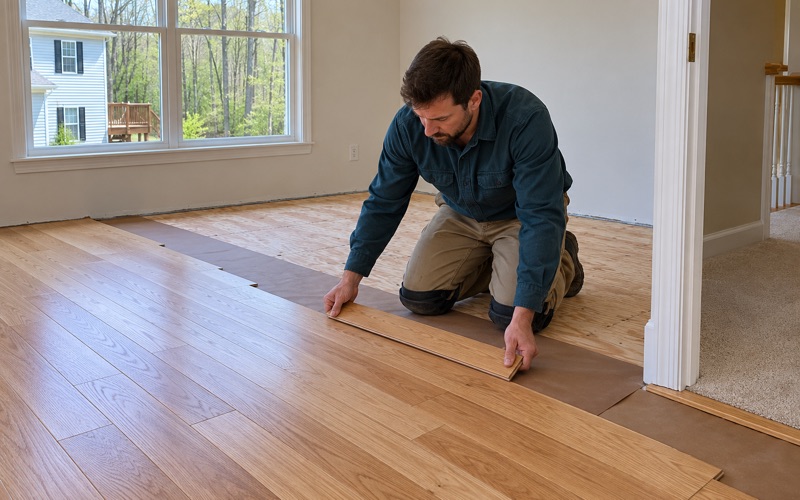
Rowhouses that have been converted, combined or updated over the years leave holes in the floor: a radiator that was removed, a floor register that moved, a partition wall taken down to open up the middle room. We patch those with board replacement woven into the existing pattern, rather than a square plug that reads as a patch from across the room.
The same approach works for termite damage, powderpost beetle holes with frass still in them, and boards that have split or gone soft near a leaking radiator. We cut back to sound wood, tie new tongue and groove boards into the old ones and sand the repair level with the rest of the room.
Stairs, squeaks and nail pops
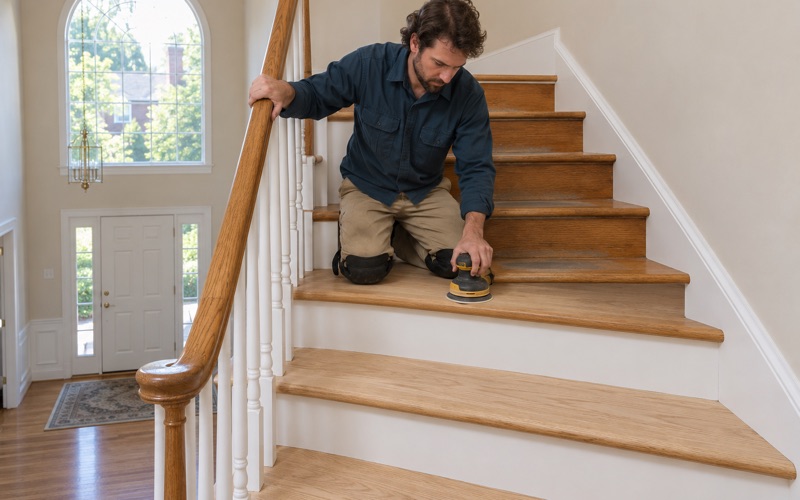
The narrow stair in a rowhouse takes more abuse than any room in a rental. We quote stairs tread by tread, because the time goes into each tread, riser and stair nosing rather than into square footage. Worn treads can often be sanded and refinished, and badly split ones can be replaced individually.
Squeaky floorboards and nail pops are common in floors this old, where the original face nails have loosened over a century of foot traffic. We reset or replace fasteners and secure loose boards to the subfloor before sanding, so a tenant does not move into a freshly finished floor that still creaks at every step.
Owner-Occupants and Planning Around the Calendar
Owner-occupied homes on and near the square
Owners live in 1,750 of the area’s 5,410 occupied homes, and 1,630 of those are attached rowhouses. Those jobs tend to be less about turnover and more about bringing an old floor back to what it was: sanding off wax residue and orange oak finishes from past decades, closing up winter gaps between boards, or matching a repair to heart pine that has darkened over many years.
For owners, we lay stain and sheen samples directly on the floor in their own light before anything is chosen, since old pine and oak take color very differently from new wood. We also seal off the rooms being worked on, closing doors and returns and using a HEPA vacuum, so the dust stays where the work is and the rest of the house remains livable.
Building a schedule backward from a date
The first thing we ask a landlord is the date the unit has to be ready, whether that is a lease start, a license renewal or a lead certification appointment. From there we work backward: the time to pull carpet and tack strip, the sanding or recoat, the coats of finish, the cure, and a buffer for anything we find under the carpet that changes the plan.
If a floor turns out to be too thin to sand again, or there is water damage underneath that has to be dried and read with a moisture meter first, we say so early, while there is still time on the calendar to adjust. A surprise found in week three is far more expensive than one found during the walkthrough.
Paperwork a landlord can file
Every job comes with a written, itemized estimate and a matching itemized invoice. Landlords tell us they keep them in the property file, and an invoice that separates sanding, repair and finish gives the supporting documentation Maryland’s security deposit law asks for when a deduction is taken for damage beyond normal wear.
When the cause is water, from a leaking radiator, a failed supply line or an upstairs bathroom, we trace it, document the readings and the damage room by room, and give the owner a record to hand to the adjuster. That keeps the insurance side of a turnover moving at the same pace as the floor work.
- 20+ Years on Wood Floors
- Written, Itemized Estimates
- Dust Sealed Into the Work Area